Weldon House

Why it's listed
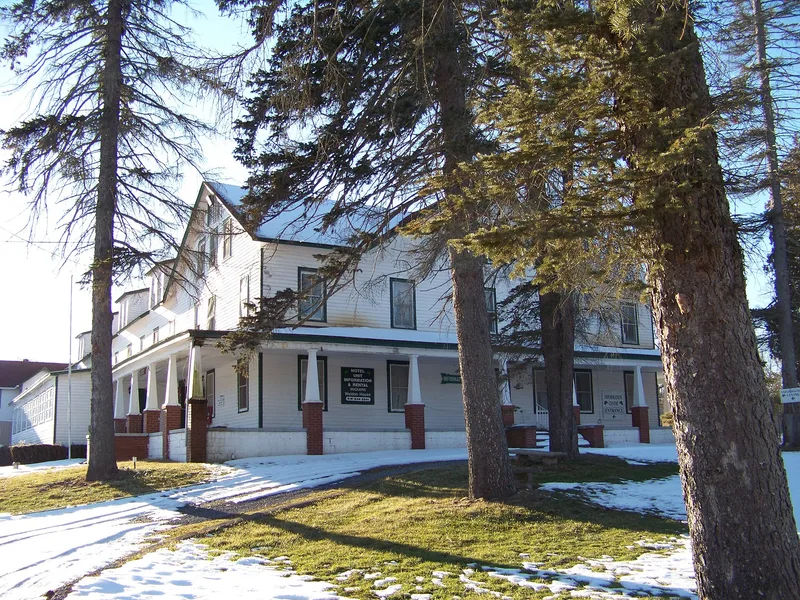
Built in 1923 in the hamlet of East Durham, this two-story frame hotel with a long rear ell was erected by partners named Weldon and Pfeiffer to host vacationers arriving from New York City. White clapboard siding, rows of two-over-two windows, gable roofs with dormers and a broad veranda on three sides define its look. Inside are 60 guest rooms that once housed up to 140 people, plus a large dining room enlarged in 1965. Interior plans of the main house remain essentially intact from 1923. The hotel is a rare survivor of the large single-building resorts that once lined Route 145, most of which gave way to bungalow colonies and motels after World War II. It is also tied to East Durham's growth as an Irish resort destination from the 1950s onward. Closed and vacant since 1989, it was later acquired by an Irish cultural and sports centre for use as a museum and cultural center. The nominated area covers about three acres and includes several support buildings.
Significance in brief: It is a distinctive and rare surviving example of a large single-unit Catskills resort "house" from the early twentieth century, at a time when most resorts shifted to bungalow and motel layouts. It is also linked to East Durham's emergence as an Irish resort area, especially from the 1950s. The form calls it the largest and most architecturally distinctive of the area's resorts.
Machine-generated summary. This summary was generated by a language model from the official nomination document and has not been reviewed line by line by an editor. It may contain errors. Check the source document before relying on any detail. Source: nomination document (PDF) · National Archives catalog entry. NRHP reference 99001658, listed January 7, 2000. Summary generated October 2026 (model claude-sonnet-5-5, prompt v1.0-2026-10-29, confidence high).
Key facts
| Address | NY 145, East Durham |
|---|---|
| County | Greene County |
| Listed | January 7, 2000 |
| Reference number | 99001658 |
| Resource type | Building |
| Period of significance | 1923-1949 |
| Architectural style | Other/Vernacular |
| Criteria |
|
| Areas of significance | Architecture, Entertainment/Recreation |
| Level of significance | Local |
| Status (as stated in the nomination) | The house has been closed and vacant since 1989; it was recently bought by an Irish cultural and sports centre for use as a museum and cultural center. |
| Acreage | 3 |
| Coordinates | 42.36527, -74.08103 (NPS GIS) |
What listing means for this property
National Register listing is honorary for a privately owned home: it does not by itself restrict what an owner may do with their own money, and it does not require public access. Restrictions come from local landmark or historic-district ordinances, which are separate (how they differ).
Owner-occupied houses are not eligible for the 20% federal rehabilitation tax credit, which applies to income-producing buildings, but many states offer credits for homeowners. Listing also opens the door to preservation easements and to buying a plaque. Start with what listing means for homeowners, renovating a listed house and selling one.
Noted as vacant in the nomination. Nomination documents can be decades old; current status may differ. If you are considering buying an empty listed property, read the due-diligence checklist.
General information, not legal or tax advice. Rules change; confirm with your State Historic Preservation Office or a qualified adviser.
Sources and further reading
- National Park Service, National Register of Historic Places database (snapshot May 2026), reference 99001658.
- Nomination form (PDF, National Archives) — catalog entry
- Wikipedia article (used for cross-checking only; text not reproduced here)
- Wikidata Q7980903
- This listing as JSON
Last updated October 2026. Found an error? See the editorial policy for how to report it.