Mt. Van Hoevenberg Olympic Bobsled Run

Why it's listed
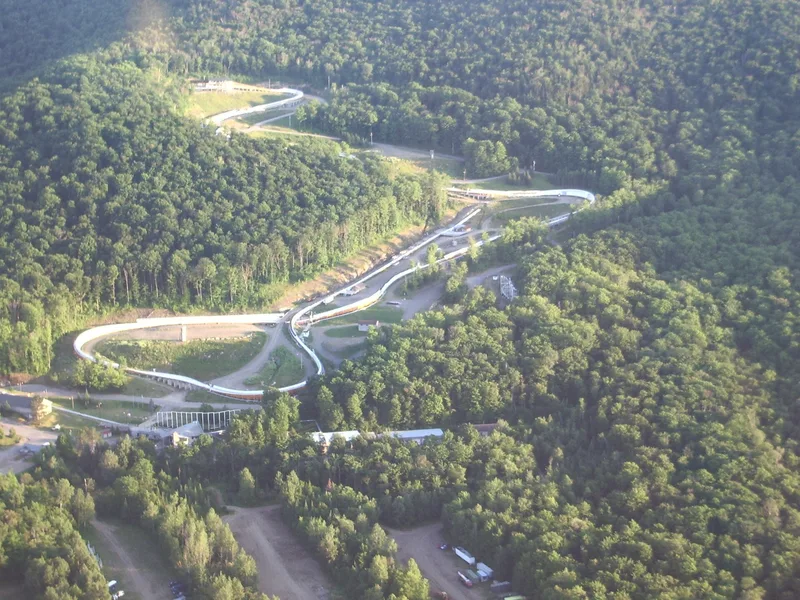
Carved out of forested mountainside east of Lake Placid, this one-and-a-half-mile bobsled run was built in 1930 for the 1932 Winter Olympics. Designed by German engineer Stanislaus Zentzytzki and built by local contractor Leo A. Malone under engineer Henry Homburger, it used earth for the straightaways and stone for twenty-two named curves. Water pipes buried underground supplied the spray that produced the icy surface. It was the first bobsled course built in the United States and longer, steeper and faster than European runs. Godfrey Dewey helped secure the Olympic bid, state funding and the site. American teams won two gold medals and one silver here in 1932, and the success sparked national interest in the sport. About 600 feet of track, including the Whiteface curve, was lost to a 1999 combined luge and bobsled track, but more than 90 percent of the run survives. The nominated resources are the run, its access road and the original steel water tank.
Significance in brief: The nomination argues national significance through the run's association with the 1932 Winter Olympics, its role in the growth of bobsledding in the United States, and its status as a rare early example of bobsled run design and construction. It also ties the run to Lake Placid's development as a winter sports center.
Machine-generated summary. This summary was generated by a language model from the official nomination document and has not been reviewed line by line by an editor. It may contain errors. Check the source document before relying on any detail. Source: nomination document (PDF) · National Archives catalog entry. NRHP reference 10000008, listed February 4, 2010. Summary generated October 2026 (model claude-sonnet-5-5, prompt v1.0-2026-10-29, confidence high).
Key facts
| Address | 220 Bob Run Ln., Lake Placid |
|---|---|
| County | Essex County |
| Listed | February 4, 2010 |
| Reference number | 10000008 |
| Resource type | Structure |
| Period of significance | 1930-1932 |
| Architect / builder | Stanislaus Zentzysky, designer; Leo A. Malone, builder; Henry Homburger, engineer |
| Criteria |
|
| Areas of significance | Entertainment/Recreation, Engineering |
| Level of significance | National |
| Status (as stated in the nomination) | Part of the run remains in use for public sledding. About 600 feet, including the Whiteface curve, was destroyed by a 1999 combined luge and bobsled track and is excluded from the nomination. The upper half-mile has been abandoned for competition but is intact. |
| Acreage | 23 |
| Coordinates | 44.21700, -73.92557 (NPS GIS) |
What listing means for this property
National Register listing is honorary: it recognises significance and does not restrict what a private owner may do without federal money or permits. It unlocks the 20% federal rehabilitation tax credit for income-producing buildings, state credits in many states, and Section 106 review when federal agencies are involved. See what listing means in practice.
General information, not legal or tax advice. Rules change; confirm with your State Historic Preservation Office or a qualified adviser.
Sources and further reading
- National Park Service, National Register of Historic Places database (snapshot May 2026), reference 10000008.
- Nomination form (PDF, National Archives) — catalog entry
- Wikipedia article (used for cross-checking only; text not reproduced here)
- Wikidata Q3389263
- This listing as JSON
Last updated October 2026. Found an error? See the editorial policy for how to report it.