Ironville Historic District

Why it's listed
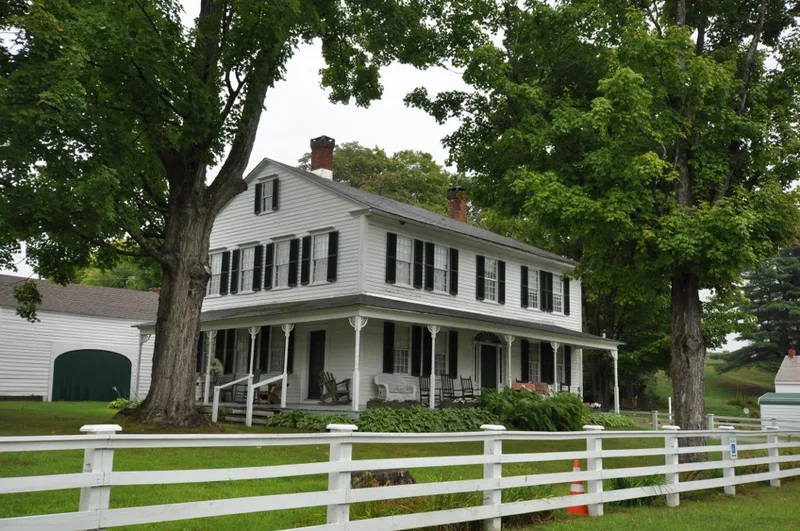
Ironville is a small Adirondack hamlet west of Crown Point in Essex County, New York. The district includes the Penfield Homestead of 1828, the cemetery and eleven other buildings along Furnace Road, plus part of Penfield Pond and the sites of demolished industrial structures. Almost nothing remains of the ironworks, which once had a dozen buildings, but the modest wooden dwellings, a Congregational Church of 1842, a parsonage, a boarding house of 1827 and a grange hall built as a store in the 1870s survive. The hamlet grew after Allen Penfield and Timothy Taft began making iron in the late 1820s, helped by the Champlain Canal, forests for charcoal and water power. Its ore was valued for purity, and a magnetic separator there led to an electromagnet that Thomas Davenport bought in 1833, which fed his work on the electric motor. The Penfield Homestead now serves as a museum.
Significance in brief: Ironville was a focal point of the Adirondack iron industry for over seventy years. As a by-product of that industry, it became the site of the first industrial use of electricity and indirectly contributed to the invention of the electric motor. The surviving wooden buildings also illustrate Federal, Greek Revival and Italianate influences.
Machine-generated summary. This summary was generated by a language model from the official nomination document and has not been reviewed line by line by an editor. It may contain errors. Check the source document before relying on any detail. Source: nomination document (PDF) · National Archives catalog entry. NRHP reference 74001237, listed December 27, 1974. Summary generated October 2026 (model claude-sonnet-5-5, prompt v1.0-2026-10-29, confidence medium).
Key facts
| Address | Area surrounding Ironville including Furnace St. and Penfield Pond, Ironville |
|---|---|
| County | Essex County |
| Listed | December 27, 1974 |
| Reference number | 74001237 |
| Resource type | District |
| Period of significance | 19th Century |
| Architectural style | Federal and Greek Revival influences, with an Italian villa-style former store |
| Areas of significance | Industry, Architecture, Invention |
| Level of significance | State |
| Status (as stated in the nomination) | The ironworks buildings are gone, leaving ruins, cellar holes and archeological sites. The dwellings, church, boarding house, grange hall and schoolhouse survive, and the Penfield Homestead is now a museum. |
| Acreage | 73 |
| Coordinates | 43.92142, -73.53493 (NPS GIS) |
What listing means for this property
This is a historic district. Buildings within its boundary are either contributing (they add to the district's significance) or non-contributing. Owners of contributing income-producing buildings can claim the 20% federal rehabilitation tax credit; homeowners should look at state credits. National Register districts impose no design review by themselves; a local historic district ordinance, if one exists, does (the difference explained).
General information, not legal or tax advice. Rules change; confirm with your State Historic Preservation Office or a qualified adviser.
Sources and further reading
- National Park Service, National Register of Historic Places database (snapshot May 2026), reference 74001237.
- Nomination form (PDF, National Archives) — catalog entry
- Wikipedia article (used for cross-checking only; text not reproduced here)
- Wikidata Q6073317
- This listing as JSON
Last updated October 2026. Found an error? See the editorial policy for how to report it.