Beekman Meeting House and Friends' Cemetery

Why it's listed
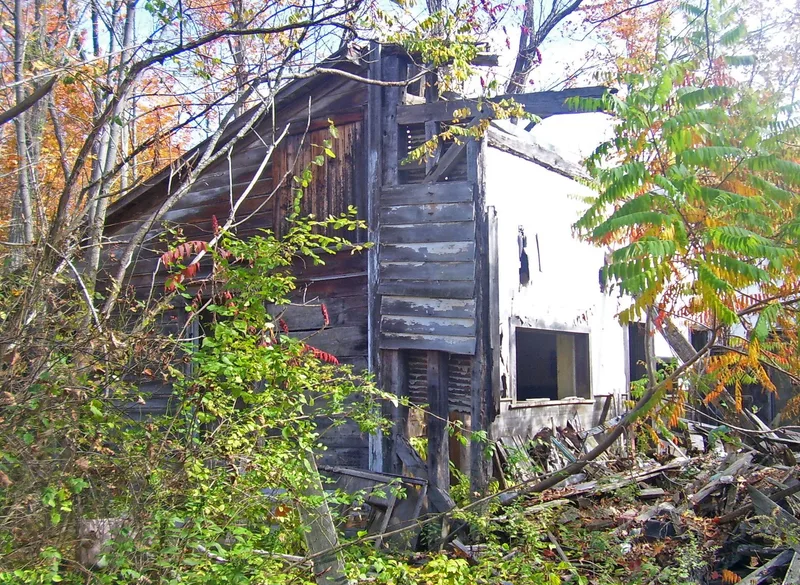
Built about 1809 on Emans Road in Arthursburg, this one-and-a-half-story Quaker meeting house replaced an earlier, plain square building used by the Beekman Meeting, which had split from the nearby Oswego Meeting around 1790. It has a gable roof, a long rectangular plan and a symmetrical west facade with two entrances, and interior evidence shows where a central partition once divided the space. A small Quaker cemetery with simple nineteenth-century stones lies on a separate parcel about 600 feet away. After the Quaker split of 1828, Beekman stayed with the Orthodox branch but never hired a pastor, and its membership dwindled. Early in the twentieth century a Grange rented and then owned the building, adding lean-tos and a cinder block rear addition before disbanding in the 1940s. The meeting house is now deteriorated, vandalized and overgrown, yet it keeps enough original form and detail to illustrate Quaker building traditions in Dutchess County.
Significance in brief: The meeting house is argued to be a representative example of traditional Quaker meeting house architecture and recalls the early growth of the Society of Friends in Dutchess County. It was the second building for the Beekman Meeting, an offshoot of the Oswego Meeting, and retains enough integrity of design, materials and workmanship despite deterioration. The cemetery contributes as an unusually intact traditional Quaker burying ground.
Machine-generated summary. This summary was generated by a language model from the official nomination document and has not been reviewed line by line by an editor. It may contain errors. Check the source document before relying on any detail. Source: nomination document (PDF) · National Archives catalog entry. NRHP reference 89000303, listed April 27, 1989. Summary generated October 2026 (model claude-sonnet-5-5, prompt v1.0-2026-10-29, confidence medium).
Key facts
| Address | Emans Rd., LeGrangeville |
|---|---|
| County | Dutchess County |
| Listed | April 27, 1989 |
| Reference number | 89000303 |
| Resource type | Building |
| Period of significance | c. 1809 - c. 1925 |
| Architect / builder | Architect: function carried out by meeting; builder unknown |
| Architectural style | Traditional Quaker meeting house type (Dutchess County Quaker Meeting Houses thematic group) |
| Areas of significance | Architecture, Religion |
| Level of significance | Local |
| Status (as stated in the nomination) | Abandoned and deteriorated; used as a Grange until the 1940s, then abandoned and recently vandalized. The site is overgrown with saplings and briars. |
| Acreage | 0.9 |
| Coordinates | 41.63335, -73.76672 (NPS GIS) |
What listing means for this property
Religious properties are listed for their architectural or historical significance, not their religious use. Listing is honorary and does not restrict the congregation's use of the building. The federal rehabilitation credit is generally unavailable unless part of the building is income-producing; some state programmes and preservation grants do cover religious buildings. Federal funding or permits trigger Section 106 review.
Noted as vacant in the nomination. Nomination documents can be decades old; current status may differ. If you are considering buying an empty listed property, read the due-diligence checklist.
General information, not legal or tax advice. Rules change; confirm with your State Historic Preservation Office or a qualified adviser.
Sources and further reading
- National Park Service, National Register of Historic Places database (snapshot May 2026), reference 89000303.
- Nomination form (PDF, National Archives) — catalog entry
- Wikipedia article (used for cross-checking only; text not reproduced here)
- Wikidata Q4879826
- This listing as JSON
Last updated October 2026. Found an error? See the editorial policy for how to report it.