New Stone Hall

Why it's listed
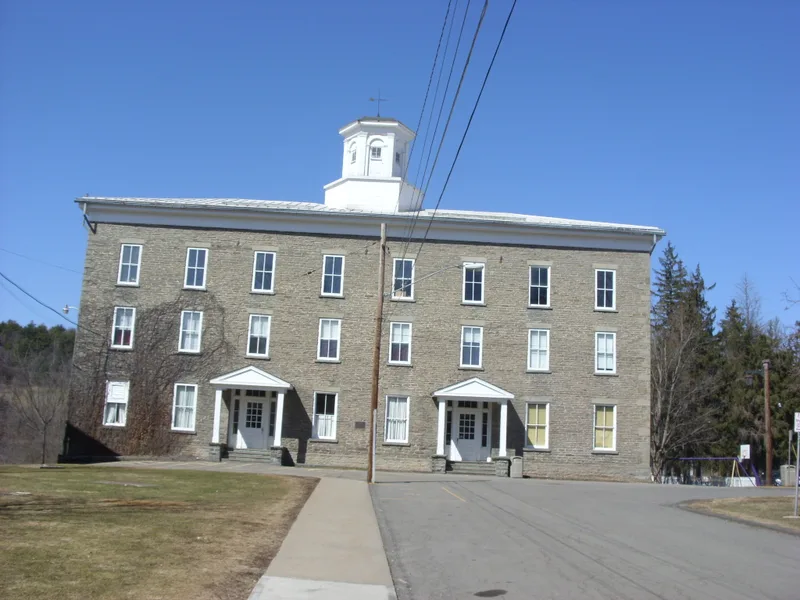
New Stone Hall is a three-story, eight-bay building of coursed rubble stone with a low slate hipped roof and a large octagonal cupola, on Center Street in Franklin, New York. It was built in 1855-56 for the Delaware Literary Institute after fire destroyed the earlier Old Stone Hall. Its simple Greek Revival design was somewhat old-fashioned for its date, and it remains the largest stone building in the area. The Institute, chartered in 1835, drew hundreds of students and sent graduates to colleges such as Harvard and Yale. After the school leased its buildings in 1902, the hall served the Union Free School and later the Franklin Central School. The first and basement floors were modernized in 1948 and remain in use. The upper floors have been vacant for decades and retain polychrome paint and nineteenth-century wallpaper. Its significance rests on its Greek Revival design and its long place in the educational and cultural life of the village.
Significance in brief: It is a fine example of vernacular Greek Revival design, built about thirty years after the style first became fashionable, and is the largest and most imposing stone building in the area. It also matters for its role in Franklin's educational and cultural life, first as the main academic building of the Delaware Literary Institute, then as classrooms for the Union Free School and the Franklin Central School.
Machine-generated summary. This summary was generated by a language model from the official nomination document and has not been reviewed line by line by an editor. It may contain errors. Check the source document before relying on any detail. Source: nomination document (PDF) · National Archives catalog entry. NRHP reference 80002600, listed May 6, 1980. Summary generated October 2026 (model claude-sonnet-5-5, prompt v1.0-2026-10-29, confidence high).
Key facts
| Address | Center St., Franklin |
|---|---|
| County | Delaware County |
| Listed | May 6, 1980 |
| Reference number | 80002600 |
| Resource type | Building |
| Period of significance | 1800-1899 (specific dates 1855-56) |
| Architectural style | Greek Revival (vernacular) |
| Areas of significance | Education, Architecture |
| Level of significance | Local |
| Status (as stated in the nomination) | Partially abandoned; the upper floor has been unused since 1932, and only the first and basement floors, modernized in 1948, are in use. Condition is listed as fair, with alterations. |
| Acreage | 0.9 |
| Within district | Franklin Village Historic District |
| Coordinates | 42.33898, -75.16786 (NPS GIS) |
What listing means for this property
National Register listing is honorary for a privately owned home: it does not by itself restrict what an owner may do with their own money, and it does not require public access. Restrictions come from local landmark or historic-district ordinances, which are separate (how they differ).
Owner-occupied houses are not eligible for the 20% federal rehabilitation tax credit, which applies to income-producing buildings, but many states offer credits for homeowners. Listing also opens the door to preservation easements and to buying a plaque. Start with what listing means for homeowners, renovating a listed house and selling one.
General information, not legal or tax advice. Rules change; confirm with your State Historic Preservation Office or a qualified adviser.
Sources and further reading
- National Park Service, National Register of Historic Places database (snapshot May 2026), reference 80002600.
- Nomination form (PDF, National Archives) — catalog entry
- Wikipedia article (used for cross-checking only; text not reproduced here)
- Wikidata Q7011957
- This listing as JSON
Last updated October 2026. Found an error? See the editorial policy for how to report it.