Cincinnatus Historic District

Why it's listed
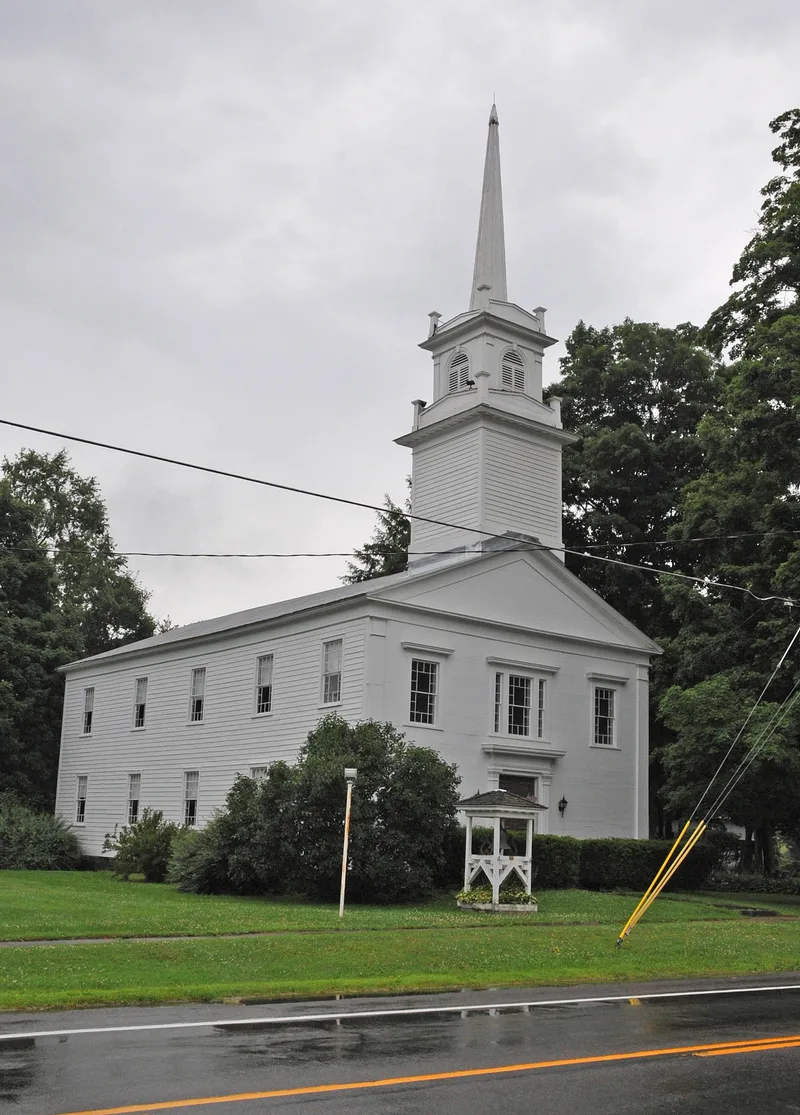
Cincinnatus Historic District occupies a small residential neighborhood on the west bank of the Otselic River, at Main Street and Taylor Avenue. It includes 14 properties: a former Congregational church, a public library, 12 residences and many carriage barns, garages and sheds. Buildings date from about 1830 to 1930 and are almost all vernacular wood-frame structures. The earliest, from the 1830s, show Federal details with hints of Greek Revival. Later houses reflect Carpenter Gothic, Italianate and Queen Anne influences. The 1831 church, now Heritage Hall, is the key building, and the brick and limestone Kellogg Free Library of 1930, designed by Carl W. Clark, is a Neo-Georgian addition. The district was settled in the early 1790s Military Tract era, and its houses reflect later dairy-related prosperity and the 1898 arrival of a railroad branch. Economic decline after the 1930s left this area free of modern intrusions, so the group is the largest intact collection of historic buildings in the hamlet.
Significance in brief: The nomination argues it is an unusually well-preserved enclave showing the hamlet's growth between 1830 and 1930. It contains a Federal-style church, a Neo-Georgian library and modest vernacular houses showing the range of styles in Central New York. Its cohesion of scale, materials and setbacks, and the absence of modern intrusions, set it apart from the rest of the hamlet.
Machine-generated summary. This summary was generated by a language model from the official nomination document and has not been reviewed line by line by an editor. It may contain errors. Check the source document before relying on any detail. Source: nomination document (PDF) · National Archives catalog entry. NRHP reference 84002208, listed September 7, 1984. Summary generated October 2026 (model claude-sonnet-5-5, prompt v1.0-2026-10-29, confidence medium).
Key facts
| Address | Main St. and Taylor Ave., Cincinnatus |
|---|---|
| County | Cortland County |
| Listed | September 7, 1984 |
| Reference number | 84002208 |
| Resource type | District |
| Period of significance | c. 1830-1930 |
| Architect / builder | Carl W. Clark of Cortland and Syracuse (Kellogg Free Library); Judge Oliver Kingman (Kingman-Pryor residence) |
| Architectural style | Federal and Federal-Greek Revival transitional, Carpenter Gothic, Italianate, Queen Anne, Neo-Georgian; mostly vernacular |
| Areas of significance | Architecture |
| Level of significance | Local |
| Status (as stated in the nomination) | Described as well preserved and largely unaltered; the former church is now Heritage Hall, and most buildings are occupied, mainly as private residences. |
| Acreage | 11.5 |
| Coordinates | 42.54250, -75.90236 (NPS GIS) |
What listing means for this property
This is a historic district. Buildings within its boundary are either contributing (they add to the district's significance) or non-contributing. Owners of contributing income-producing buildings can claim the 20% federal rehabilitation tax credit; homeowners should look at state credits. National Register districts impose no design review by themselves; a local historic district ordinance, if one exists, does (the difference explained).
General information, not legal or tax advice. Rules change; confirm with your State Historic Preservation Office or a qualified adviser.
Sources and further reading
- National Park Service, National Register of Historic Places database (snapshot May 2026), reference 84002208.
- Nomination form (PDF, National Archives) — catalog entry
- Wikipedia article (used for cross-checking only; text not reproduced here)
- Wikidata Q5120361
- This listing as JSON
Last updated October 2026. Found an error? See the editorial policy for how to report it.