Upperville Meeting House

Why it's listed
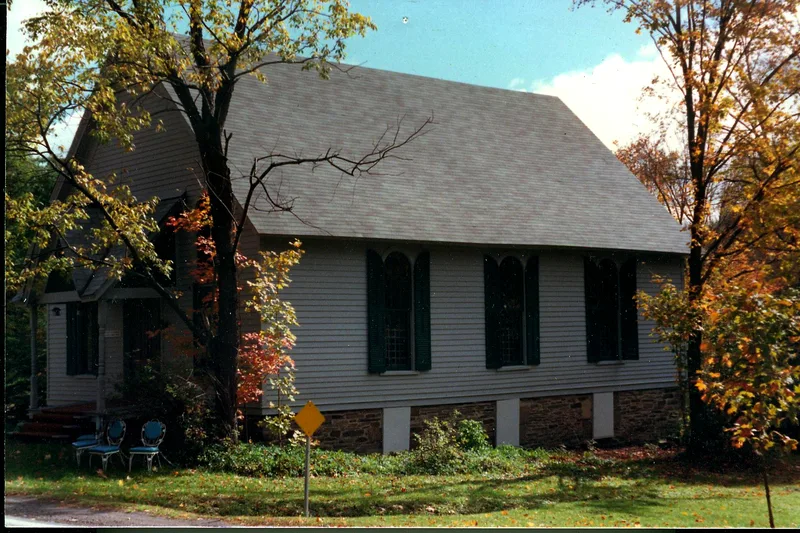
Set close to NY 80 in the small hamlet of Upperville, this one-story wood-frame meeting house was completed in 1896-97 for the Society of Friends. It rests on a dressed stone foundation under a steep gable roof and has clapboard siding, tall round-arched windows, and a small portico with turned posts. Inside, a vestibule leads to an open meeting room finished in beaded board, with a small platform and a rear gallery. It was the fifth meeting place used by Quakers in the town of Smyrna since their arrival around 1800. Herbert Dixon, a Congregationalist, bought the land and gave it to the Friends on condition that they hold meetings there for ten years. The design combines features of vernacular Protestant churches with a restrained, nonhierarchical interior, reflecting the cooperation between Orthodox and Hicksite Quakers in Smyrna. Few alterations have been made, and the building still serves an active congregation.
Significance in brief: The nomination argues it is a remarkably intact late nineteenth-century Quaker meeting house, tied to Chenango County's large Quaker population. It was the fifth Quaker meeting place in Smyrna. Its design blends Orthodox, church-like features with the plainness associated with Hicksite tradition, reflecting the loose division between the two groups locally.
Machine-generated summary. This summary was generated by a language model from the official nomination document and has not been reviewed line by line by an editor. It may contain errors. Check the source document before relying on any detail. Source: nomination document (PDF) · National Archives catalog entry. NRHP reference 02000307, listed April 1, 2002. Summary generated October 2026 (model claude-sonnet-5-5, prompt v1.0-2026-10-29, confidence high).
Key facts
| Address | NY 80, Upperville |
|---|---|
| County | Chenango County |
| Listed | April 1, 2002 |
| Reference number | 02000307 |
| Resource type | Building |
| Period of significance | 1896-97 |
| Architectural style | Late Victorian |
| Criteria |
|
| Areas of significance | Architecture, Social History |
| Level of significance | Local |
| Status (as stated in the nomination) | Still used for religious purposes, with an active membership; described as completely intact to its period of construction apart from a few small alterations. |
| Acreage | 0.9 |
| Coordinates | 42.70002, -75.61566 (NPS GIS) |
What listing means for this property
Religious properties are listed for their architectural or historical significance, not their religious use. Listing is honorary and does not restrict the congregation's use of the building. The federal rehabilitation credit is generally unavailable unless part of the building is income-producing; some state programmes and preservation grants do cover religious buildings. Federal funding or permits trigger Section 106 review.
General information, not legal or tax advice. Rules change; confirm with your State Historic Preservation Office or a qualified adviser.
Sources and further reading
- National Park Service, National Register of Historic Places database (snapshot May 2026), reference 02000307.
- Nomination form (PDF, National Archives) — catalog entry
- Wikipedia article (used for cross-checking only; text not reproduced here)
- Wikidata Q7899082
- This listing as JSON
Last updated October 2026. Found an error? See the editorial policy for how to report it.