Oxford Village Historic District
Also known as: See Also:Burr, Theodore, House

Why it's listed
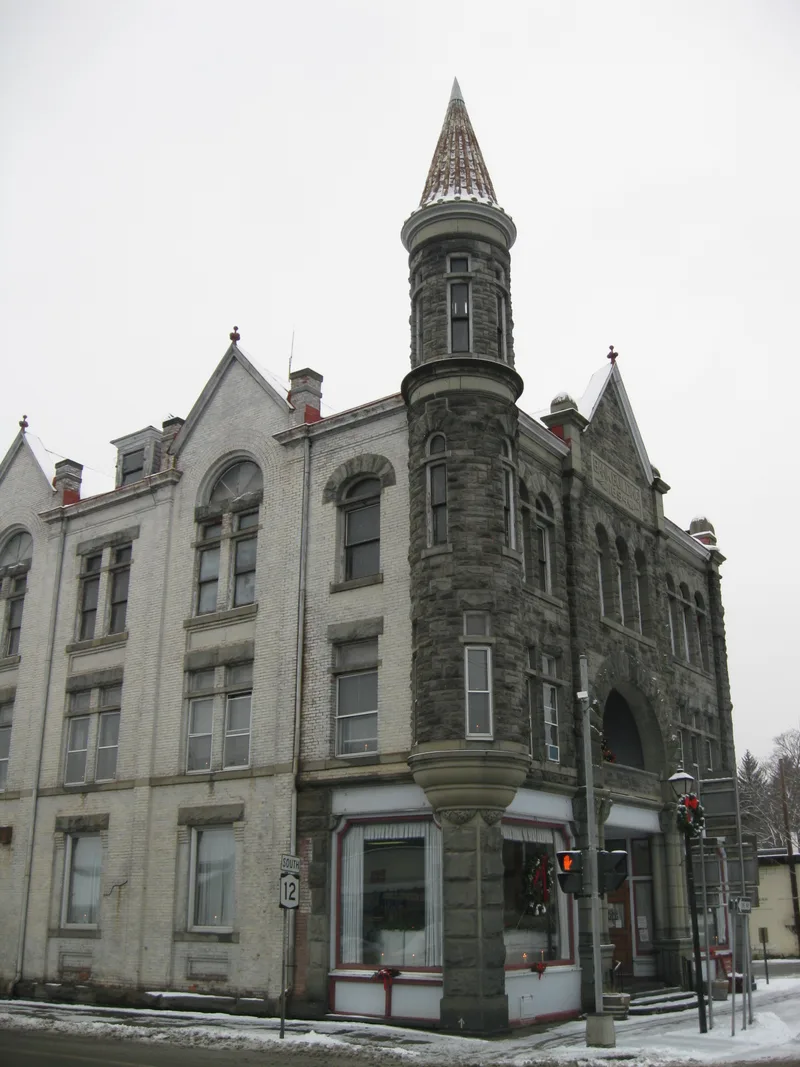
Oxford's historic core spreads across both banks of the Chenango River in south-central New York. About 85 acres hold 201 contributing buildings, ranging from Federal and Greek Revival houses to Italianate, Queen Anne and Eastlake residences, along with bluestone and frame churches, a commercial block around Lafayette Park, and a railroad complex near the former Delaware, Lackawanna and Western line. Notable works include Theodore Burr's 1810-12 house, St. Paul's Episcopal Church designed by Henry Dudley, and several buildings by Binghamton architect T.I. Lacey. The district matters because it traces the village's growth from its first frame dwelling in 1794, through its days as a turnpike and academy town, its rise as a commercial center after the Chenango Canal opened in 1837, and the arrival of rail service in 1870. Little redevelopment in the twentieth century left its nineteenth-century character largely intact. The 1939 Post Office, with its Depression-era mural, is also noted.
Significance in brief: The nomination argues the district is a largely intact village core reflecting the growth of a small south-central New York valley community from 1794 to 1930. It recalls Oxford's role as an educational, commercial and transportation center, with churches and houses by architects of regional and statewide importance. The 1939 Post Office is individually significant as a Depression-era federal civic building with a mural.
Machine-generated summary. This summary was generated by a language model from the official nomination document and has not been reviewed line by line by an editor. It may contain errors. Check the source document before relying on any detail. Source: nomination document (PDF) · National Archives catalog entry. NRHP reference 85002481, listed September 17, 1985. Summary generated October 2026 (model claude-sonnet-5-5, prompt v1.0-2026-10-29, confidence medium).
Key facts
| Address | Roughly Washington Ave., State St., Chenango River, Merchant & Green Sts., Washington Park, Albany & Pleasant Sts., Oxford |
|---|---|
| County | Chenango County |
| Listed | September 17, 1985 |
| Reference number | 85002481 |
| Resource type | District |
| Period of significance | c. 1794-1830; 1939 |
| Architect / builder | Various, Theodore Burr, Henry Dudley, T.I. Lacey, and Isaac Perry |
| Architectural style | Federal, Greek Revival, Gothic Revival, Italianate, Queen Anne, Eastlake, Colonial Revival, Richardsonian Romanesque |
| Areas of significance | Education, Architecture, Social History |
| Level of significance | Local |
| Status (as stated in the nomination) | Described as retaining a high degree of overall integrity, with about one-third of residences having modern siding added; 32 non-historic buildings are in the district. |
| Acreage | 85 |
| Coordinates | 42.44194, -75.59329 (NPS GIS) |
What listing means for this property
This is a historic district. Buildings within its boundary are either contributing (they add to the district's significance) or non-contributing. Owners of contributing income-producing buildings can claim the 20% federal rehabilitation tax credit; homeowners should look at state credits. National Register districts impose no design review by themselves; a local historic district ordinance, if one exists, does (the difference explained).
General information, not legal or tax advice. Rules change; confirm with your State Historic Preservation Office or a qualified adviser.
Sources and further reading
- National Park Service, National Register of Historic Places database (snapshot May 2026), reference 85002481.
- Nomination form (PDF, National Archives) — catalog entry
- Wikipedia article (used for cross-checking only; text not reproduced here)
- Wikidata Q7115545
- This listing as JSON
Last updated October 2026. Found an error? See the editorial policy for how to report it.