Chautauqua Institution Historic District
Also known as: Chatauqua Assembly

Why it's listed
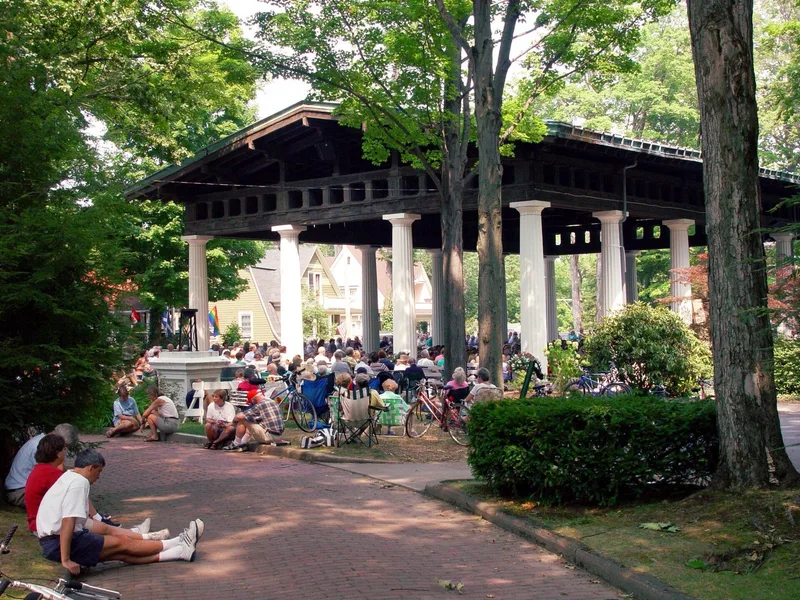
Chautauqua Institution is a 207-acre wooded community along about a mile and a half of Chautauqua Lake shoreline in western New York, enclosed by an iron fence. Cottages, public halls, parks and open spaces sit close together, and the architecture is mainly Victorian, with Gingerbread, Gothic Bracketted and Swiss Chalet details. Landmarks include the 1893 Amphitheater designed by Lewis Miller, the 1881 Athenaeum Hotel, the Hall of Philosophy modeled after the Parthenon, and Palestine Park, a scaled model of the Holy Land begun in 1874. The community grew from a summer assembly founded in 1874 by Lewis Miller and John H. Vincent for Sunday School teachers. It expanded into language, education, theology, arts and music programs, and launched the Chautauqua Literary and Scientific Circle, a four-year home reading course for adults. Its platform also hosted debate on public questions, and its music, opera and theatre programs developed in the early twentieth century. It was listed as a district for educational, religious, social and architectural significance.
Significance in brief: The nomination argues that Chautauqua was a leading force in American adult and summer education, begun in 1874 by Lewis Miller and John H. Vincent. It also served as a forum for public issues and a center for music and the arts. Architecturally it is described as a living museum of varied styles, mostly Victorian.
Machine-generated summary. This summary was generated by a language model from the official nomination document and has not been reviewed line by line by an editor. It may contain errors. Check the source document before relying on any detail. Source: nomination document (PDF) · National Archives catalog entry. NRHP reference 73001168, listed June 19, 1973. Summary generated October 2026 (model claude-sonnet-5-5, prompt v1.0-2026-10-29, confidence medium).
Key facts
| Address | Bounded by Chautauqua Lake, North and Lowell Aves., and NY 17-J, Chautauqua |
|---|---|
| County | Chautauqua County |
| Listed | June 19, 1973 |
| Reference number | 73001168 |
| Resource type | District |
| Architect / builder | Lewis Miller (Amphitheater, 1893); Paul Peltz (Hall of Christ); Otis Floyd Johnson under Lorado Taft (Norton Hall); Albert Kelsey (Hall of Philosophy) |
| Architectural style | Predominantly Victorian, with Gingerbread, Gothic Bracketted and Swiss Chalet elements; Grecian style for the Hall of Philosophy |
| Areas of significance | Landscape Architecture, Education, Architecture, Religion |
| Level of significance | National |
| National Historic Landmark | Yes, designated June 29, 1989 |
| Status (as stated in the nomination) | Occupied; in use for educational, entertainment, park, private residence and religious purposes. |
| Acreage | 207 |
| Coordinates | 42.20932, -79.46766 (NPS GIS) |
What listing means for this property
This is a historic district. Buildings within its boundary are either contributing (they add to the district's significance) or non-contributing. Owners of contributing income-producing buildings can claim the 20% federal rehabilitation tax credit; homeowners should look at state credits. National Register districts impose no design review by themselves; a local historic district ordinance, if one exists, does (the difference explained).
General information, not legal or tax advice. Rules change; confirm with your State Historic Preservation Office or a qualified adviser.
Sources and further reading
- National Park Service, National Register of Historic Places database (snapshot May 2026), reference 73001168.
- Nomination form (PDF, National Archives) — catalog entry
- Wikipedia article (used for cross-checking only; text not reproduced here)
- Wikidata Q5088389
- This listing as JSON
Last updated October 2026. Found an error? See the editorial policy for how to report it.