Randolph Historic District
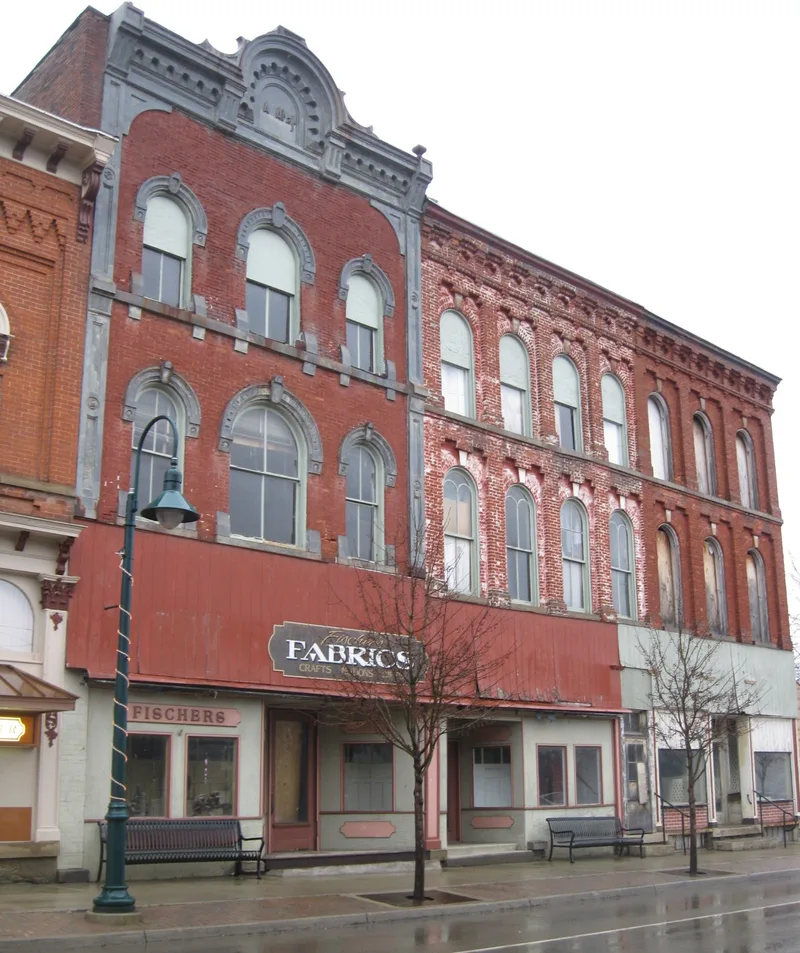

Why it's listed
Randolph's historic district takes in the village's main commercial blocks and the residential streets around them, in southwestern Cattaraugus County, New York. It holds 268 contributing buildings, one contributing site known as The Point, and one structure, with most buildings dating from 1826 to the 1880s. The east end of Main Street has two- and three-story masonry storefronts that remain largely unchanged from the 1870s commercial boom. West of the core are homes in Greek Revival, Italianate, Gothic Revival, Second Empire and Shingle styles, with Greek Revival dominant; some early land sales required that style. Industry sits on the western lots, including the 1907 Borden's Condensery, which still houses manufacturing, and the Randolph Grist Mill, built in 1853 in East Randolph and rebuilt on Main Street in 1908. Tree-lined streets, historic brick paving on Washington and Bank Streets, and consistent lot patterns give the district a character close to its late nineteenth-century appearance.
Significance in brief: The district keeps a high level of architectural integrity in materials, setting, feeling and association. It preserves a cohesive commercial core from the 1870s boom, residential streets of Greek Revival, Italianate, Gothic Revival, Second Empire and Shingle style homes, and industrial buildings such as the 1907 Borden's Condensery and the relocated Randolph Grist Mill.
Machine-generated summary. This summary was generated by a language model from the official nomination document and has not been reviewed line by line by an editor. It may contain errors. Check the source document before relying on any detail. Source: nomination document (PDF) · National Archives catalog entry. NRHP reference 12001035, listed December 12, 2012. Summary generated October 2026 (model claude-sonnet-5-5, prompt v1.0-2026-10-29, confidence medium).
Key facts
| Address | Jct. of Main & Jamestown to Borden Sts., Randolph |
|---|---|
| County | Cattaraugus County |
| Listed | December 12, 2012 |
| Reference number | 12001035 |
| Resource type | District |
| Architectural style | Greek Revival, Italianate, Gothic Revival, Second Empire and Shingle style residences; nineteenth and early twentieth century commercial styles |
| Areas of significance | Exploration/Settlement, Commerce, Architecture |
| Level of significance | Local |
| Status (as stated in the nomination) | Most buildings are still in residential, commercial, religious or government use. The Borden's factory now houses a manufacturing company. The Randolph Furniture Works and the Foundry and Machine Shop have been demolished. |
| Acreage | 158.6 |
| Coordinates | 42.16456, -78.98069 (NPS GIS) |
What listing means for this property
This is a historic district. Buildings within its boundary are either contributing (they add to the district's significance) or non-contributing. Owners of contributing income-producing buildings can claim the 20% federal rehabilitation tax credit; homeowners should look at state credits. National Register districts impose no design review by themselves; a local historic district ordinance, if one exists, does (the difference explained).
General information, not legal or tax advice. Rules change; confirm with your State Historic Preservation Office or a qualified adviser.
Sources and further reading
- National Park Service, National Register of Historic Places database (snapshot May 2026), reference 12001035.
- Nomination form (PDF, National Archives) — catalog entry
- Wikipedia article (used for cross-checking only; text not reproduced here)
- Wikidata Q14707218
- This listing as JSON
Last updated October 2026. Found an error? See the editorial policy for how to report it.