Parachute Jump

Why it's listed
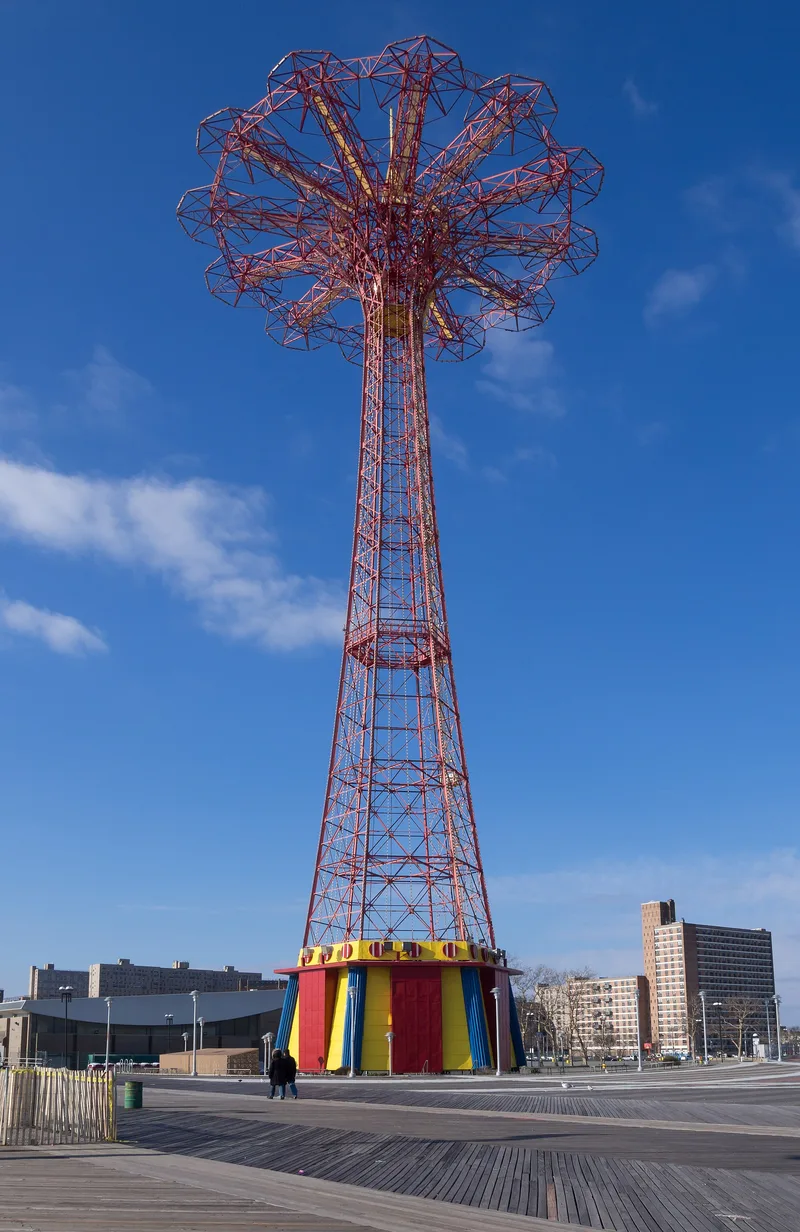
Rising 250 feet above the Coney Island boardwalk in Brooklyn, the Parachute Jump is a steel tower with twelve radiating arms, each serving as a drop point for a parachute seat. It was built for the 1939 New York World's Fair, then moved in 1941 to Steeplechase Park, founded by George C. Tilyou and run by his family. The tower flares at the base for stability, and counterbalanced cantilever trusses at the top are tied together by an inner ring and light peripheral trusswork. The nomination values it as an example of form following function, and as the only known structure of its type still standing. It was a popular attraction during World War II and later served as a landmark for aircraft and ships. Steeplechase Park closed in 1964 and its buildings and rides were demolished, but the tower remained. The structure is deteriorated and no longer operates, though it is regarded as largely intact.
Significance in brief: The nomination presents it as both an engineering achievement and a visually striking structure, and as the only known surviving example of its type. It also recalls Steeplechase Park, the largest and most popular of the Coney Island amusement areas. It is one of very few structures surviving from the 1939 World's Fair and has long served as a visual landmark.
Machine-generated summary. This summary was generated by a language model from the official nomination document and has not been reviewed line by line by an editor. It may contain errors. Check the source document before relying on any detail. Source: nomination document (PDF) · National Archives catalog entry. NRHP reference 80002645, listed September 2, 1980. Summary generated October 2026 (model claude-sonnet-5-5, prompt v1.0-2026-10-29, confidence medium).
Key facts
| Address | Coney Island, New York |
|---|---|
| County | Brooklyn |
| Listed | September 2, 1980 |
| Reference number | 80002645 |
| Resource type | Structure |
| Architect / builder | Michael Marlo & Edwin W. Kleinert (Coney Island); text also gives architect Michael Mario and engineer Edwin W. Kleinert |
| Areas of significance | Engineering, Entertainment/Recreation |
| Level of significance | Local |
| Status (as stated in the nomination) | Described as deteriorated but intact and still standing; the ride is inoperative and Steeplechase Park closed in 1964. A state survey form lists present use as vacant. |
| Acreage | 0.9 |
| Coordinates | 40.57273, -73.98464 (NPS GIS) |
What listing means for this property
National Register listing is honorary: it recognises significance and does not restrict what a private owner may do without federal money or permits. It unlocks the 20% federal rehabilitation tax credit for income-producing buildings, state credits in many states, and Section 106 review when federal agencies are involved. See what listing means in practice.
Noted as vacant in the nomination. Nomination documents can be decades old; current status may differ. If you are considering buying an empty listed property, read the due-diligence checklist.
General information, not legal or tax advice. Rules change; confirm with your State Historic Preservation Office or a qualified adviser.
Sources and further reading
- National Park Service, National Register of Historic Places database (snapshot May 2026), reference 80002645.
- Nomination form (PDF, National Archives) — catalog entry
- Wikipedia article (used for cross-checking only; text not reproduced here)
- Wikidata Q3651640
- This listing as JSON
Last updated October 2026. Found an error? See the editorial policy for how to report it.