New Lots Reformed Church and Cemetery

Why it's listed
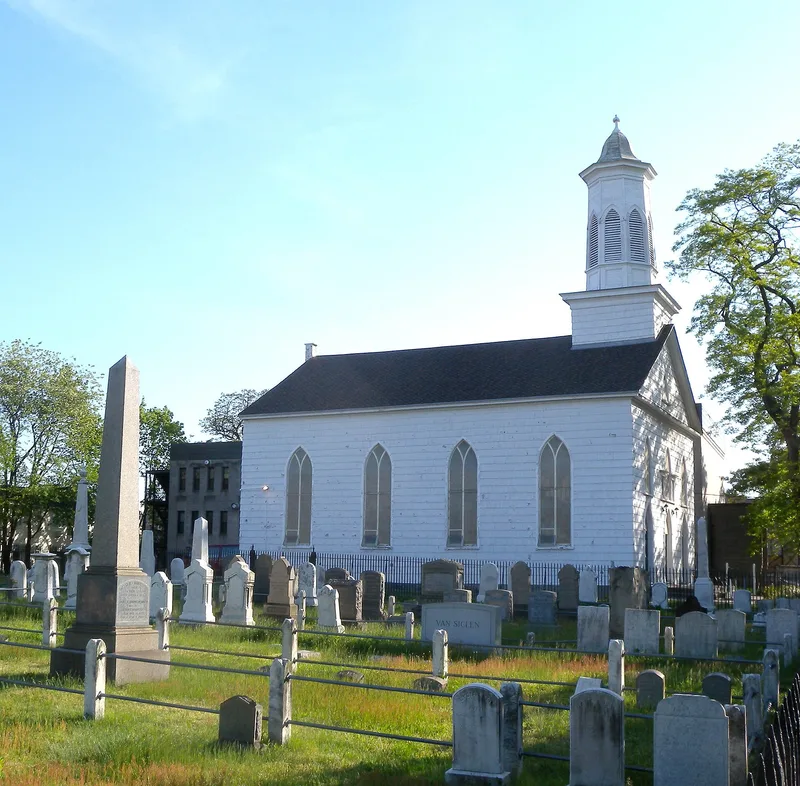
Built in 1823-24 by local farmers who felled timbers from their own land, this small wooden church at 630 New Lots Avenue in Brooklyn's Bushwick area sits on a rough stone foundation with board siding and a gabled front. Pointed-arch doors and windows, including a rare Palladian-Gothic center window, give a religious character to an otherwise plain vernacular building. Its hand-hewn timbers are notched, jointed and pegged, and a short square tower with a polygonal lantern rises from the roof ridge. The congregation belongs to the Reformed Church in America and has worshipped here continuously. The adjoining cemetery, established in 1841 when the older burial ground across the street needed to expand, contains tombstones bearing early Dutch family names such as Rapelye, Wyckoff, Vanderveer, Van Brunt and Ryerson. The church is considered architecturally unique among wooden churches of its period in New York City and a reminder of Brooklyn's early development.
Significance in brief: The nomination argues the church is a fine example of rural church architecture and is architecturally unique in New York City as a wooden church of its period. Its hand-hewn, pegged timbers show fine craftsmanship, and its simple Gothic details reflect local building traditions. The cemetery holds the graves of many early Dutch settlers of the area.
Machine-generated summary. This summary was generated by a language model from the official nomination document and has not been reviewed line by line by an editor. It may contain errors. Check the source document before relying on any detail. Source: nomination document (PDF) · National Archives catalog entry. NRHP reference 83001696, listed May 19, 1983. Summary generated October 2026 (model claude-sonnet-5-5, prompt v1.0-2026-10-29, confidence high).
Key facts
| Address | 630 New Lots Ave., New York |
|---|---|
| County | Brooklyn |
| Listed | May 19, 1983 |
| Reference number | 83001696 |
| Resource type | Building |
| Period of significance | 1824, 1841 (cemetery) |
| Architect / builder | Unknown |
| Architectural style | Gothic (vernacular rural church with Gothic details) |
| Areas of significance | Architecture |
| Level of significance | Local |
| Status (as stated in the nomination) | Listed as occupied and in religious use, with a continuous ministry since construction; condition given as fair, altered, on its original site. |
| Acreage | 2 |
| Coordinates | 40.66478, -73.88518 (NPS GIS) |
What listing means for this property
Religious properties are listed for their architectural or historical significance, not their religious use. Listing is honorary and does not restrict the congregation's use of the building. The federal rehabilitation credit is generally unavailable unless part of the building is income-producing; some state programmes and preservation grants do cover religious buildings. Federal funding or permits trigger Section 106 review.
General information, not legal or tax advice. Rules change; confirm with your State Historic Preservation Office or a qualified adviser.
Sources and further reading
- National Park Service, National Register of Historic Places database (snapshot May 2026), reference 83001696.
- Nomination form (PDF, National Archives) — catalog entry
- Wikipedia article (used for cross-checking only; text not reproduced here)
- Wikidata Q7009933
- This listing as JSON
Last updated October 2026. Found an error? See the editorial policy for how to report it.