Watervliet Arsenal

Why it's listed
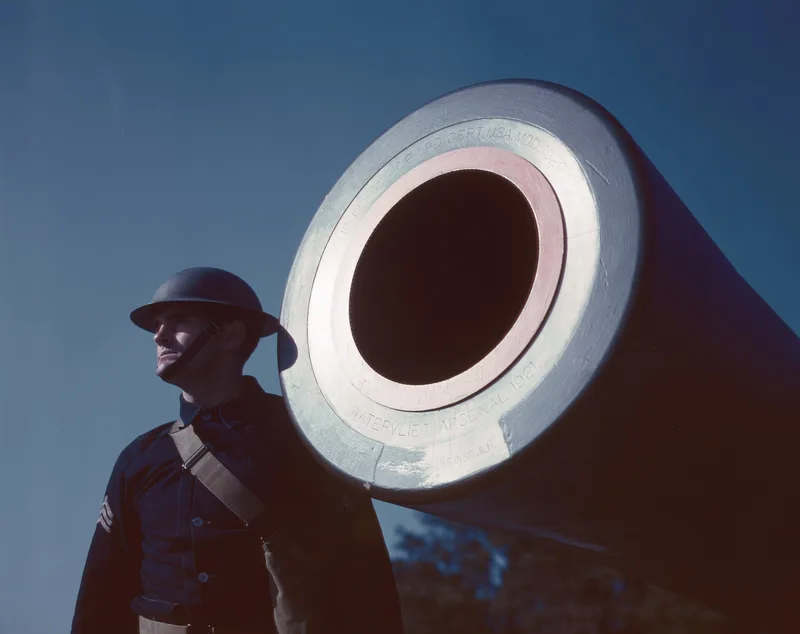
Watervliet Arsenal, on South Broadway in Watervliet, New York, began in 1813 as a War of 1812 installation and is still an active Army arsenal. Its first brick buildings are gone, and the Erie Canal, which once crossed the grounds and powered workshops, was filled in 1940. Surviving early structures include the East Powder Magazine of 1828, with four-foot-thick stone walls and the oldest building on site, a second magazine of 1849, an 1840 ammunition laboratory, and limestone quarters and barracks from the 1840s. The 1859 cast-iron storehouse, fabricated by the Architectural Iron Works of New York, now serves as an ordnance museum. The arsenal's largest role came after 1889, when a government cannon factory was built. It produced seacoast guns, America's first 16-inch gun in 1902, 465 cannon in 1918, and the first atomic cannon in 1953. That long record of weapons manufacture underlies its recognition.
Significance in brief: The arsenal has served the nation continuously since 1813, with its busiest early years during the Mexican and Civil Wars. Its greatest technological achievements followed the creation of the government cannon factory in 1889, which produced the first American 16-inch gun in 1902 and the first atomic cannon in 1953. Surviving buildings include an 1859 cast-iron storehouse and early stone magazines and quarters.
Machine-generated summary. This summary was generated by a language model from the official nomination document and has not been reviewed line by line by an editor. It may contain errors. Check the source document before relying on any detail. Source: nomination document (PDF) · National Archives catalog entry. NRHP reference 66000503, listed November 13, 1966. Summary generated October 2026 (model claude-sonnet-5-5, prompt v1.0-2026-10-29, confidence medium).
Key facts
| Address | S. Broadway, Watervliet |
|---|---|
| County | Albany County |
| Listed | November 13, 1966 |
| Reference number | 66000503 |
| Resource type | District |
| Period of significance | 1800-1899 |
| Architect / builder | Architectural Iron Works of New York (cast-iron storehouse, 1859) |
| Architectural style | Plain Classic-derived style in the limestone quarters; Greek and Roman detail on the cast-iron storehouse |
| Areas of significance | Industry, Military |
| Level of significance | National |
| National Historic Landmark | Yes, designated November 13, 1966 |
| Status (as stated in the nomination) | Active U.S. Army arsenal; the cannon shop still repairs and produces large guns, and the cast-iron storehouse is used as an ordnance museum. |
| Acreage | 110 |
| Coordinates | 42.71934, -73.70809 (NPS GIS) |
What listing means for this property
This is a historic district. Buildings within its boundary are either contributing (they add to the district's significance) or non-contributing. Owners of contributing income-producing buildings can claim the 20% federal rehabilitation tax credit; homeowners should look at state credits. National Register districts impose no design review by themselves; a local historic district ordinance, if one exists, does (the difference explained).
General information, not legal or tax advice. Rules change; confirm with your State Historic Preservation Office or a qualified adviser.
Sources and further reading
- National Park Service, National Register of Historic Places database (snapshot May 2026), reference 66000503.
- Nomination form (PDF, National Archives) — catalog entry
- Wikipedia article (used for cross-checking only; text not reproduced here)
- Wikidata Q7974555
- This listing as JSON
Last updated October 2026. Found an error? See the editorial policy for how to report it.