Stone, Joseph, House
Also known as: Potter Acres

Why it's listed
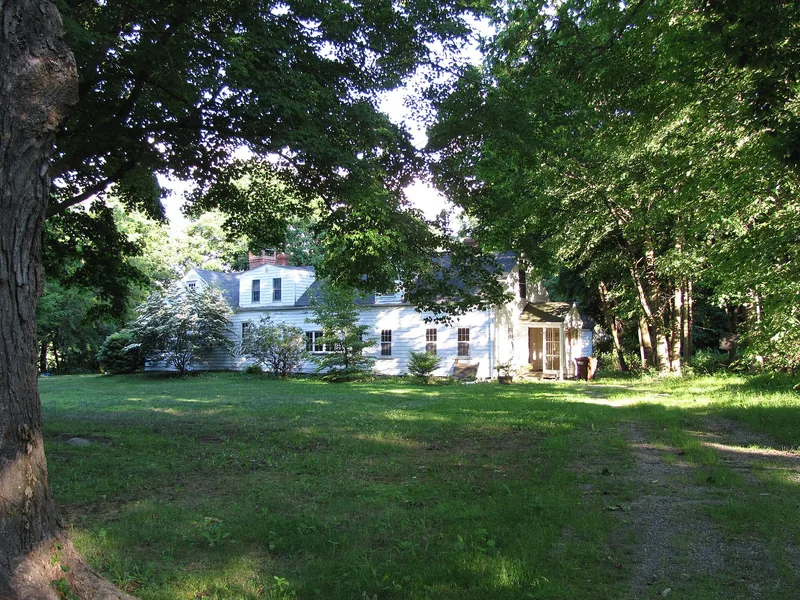
This five-acre farm property on Stone Street in southern Auburn centers on a 1 1/2-story cottage with a central entrance and a large ridge chimney. Its earliest section, a three-bay half house, was built about 1729 and is believed to be the oldest surviving residence in the town. Joseph Stone, who took possession in 1785 and enlarged the house to five bays in 1790, was Ward's town clerk, drew an early 1794 map of the town, and composed psalmody for decades, producing over 2,000 songs. Later alterations include an 1886 kitchen, bath and sunporch conversion of the ell and a single-story saltbox-style addition in 1946. Interior raised panel doors, mantelpieces and wainscoting survive. James Alger, a railroad engineer, lived here in the 19th century. The lot also holds an 18th-century shed and barn remains, and may contain prehistoric and historic archaeological deposits.
Significance in brief: The form calls it an intact colonial-period vernacular cottage, believed to be the oldest surviving residence in Auburn. It is also associated with Joseph Stone, who owned it from 1785 to 1826 and was a prolific composer of psalmody. The property also has archaeological potential, both prehistoric and historic.
Machine-generated summary. This summary was generated by a language model from the official nomination document and has not been reviewed line by line by an editor. It may contain errors. Check the source document before relying on any detail. Source: nomination document (PDF) · National Archives catalog entry. NRHP reference 86000028, listed January 9, 1986. Summary generated October 2026 (model claude-sonnet-5-5, prompt v1.0-2026-10-29, confidence high).
Key facts
| Address | 35 Stone St., Auburn |
|---|---|
| County | Worcester County |
| Listed | January 9, 1986 |
| Reference number | 86000028 |
| Resource type | Building |
| Architect / builder | Unknown |
| Architectural style | Colonial vernacular cottage (Cape/half-house form) with a Colonial Revival doorway alteration |
| Criteria |
|
| Areas of significance | Architecture, Performing Arts |
| Level of significance | Local |
| Status (as stated in the nomination) | Occupied private residence in good condition; altered in 1790, 1886 and 1946. The 1946 addition contains an apartment. |
| Acreage | 5 |
| Coordinates | 42.18534, -71.83038 (NPS GIS) |
What listing means for this property
National Register listing is honorary for a privately owned home: it does not by itself restrict what an owner may do with their own money, and it does not require public access. Restrictions come from local landmark or historic-district ordinances, which are separate (how they differ).
Owner-occupied houses are not eligible for the 20% federal rehabilitation tax credit, which applies to income-producing buildings, but many states offer credits for homeowners. Listing also opens the door to preservation easements and to buying a plaque. Start with what listing means for homeowners, renovating a listed house and selling one.
General information, not legal or tax advice. Rules change; confirm with your State Historic Preservation Office or a qualified adviser.
Sources and further reading
- National Park Service, National Register of Historic Places database (snapshot May 2026), reference 86000028.
- Nomination form (PDF, National Archives) — catalog entry
- Wikipedia article (used for cross-checking only; text not reproduced here)
- Wikidata Q14715650
- This listing as JSON
Last updated October 2026. Found an error? See the editorial policy for how to report it.