Lunenburg Historic District
Also known as: Lunenburg Center
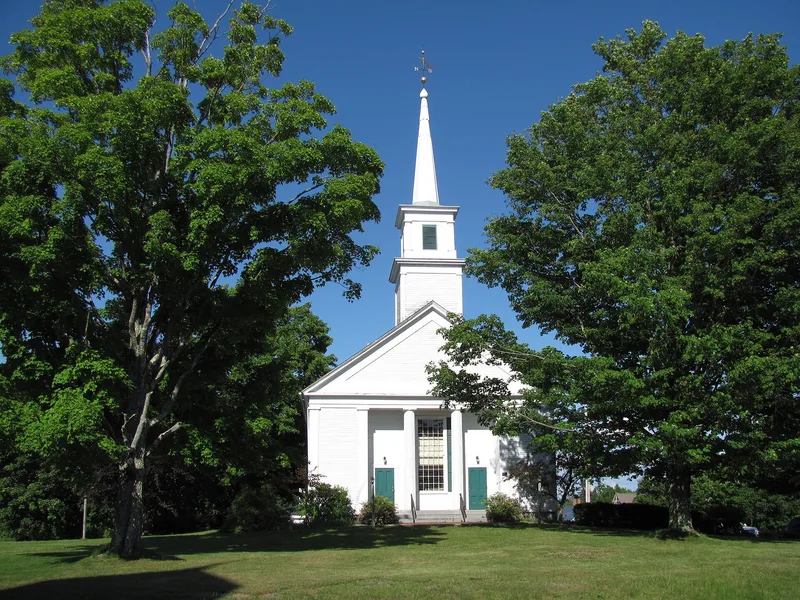

Why it's listed
Lunenburg Historic District occupies the center of a rural Massachusetts town, on high ground once known as one of the Turkey Hills. Built around an Upper Common and a Lower Common, it covers over 100 acres where main roads meet along old native trails and colonial routes. White clapboard houses line the streets, most dating from 1790 to 1860, and civic buildings face the Upper Common: a Greek Revival church from 1844, a town hall built in 1830 as a Unitarian church and moved in 1867, a store, and a 1910 Georgian Revival library. Federal and Greek Revival dwellings dominate, with Italianate and Colonial Revival examples among them. The district was listed because it shows how a small agrarian village developed, with a cohesive scale and materials despite some alterations and modern intrusions. Early meetinghouse and school sites also hold archaeological potential.
Significance in brief: The district illustrates the late 18th to mid-19th century evolution of a small, mostly agricultural New England village. It keeps its civic and religious buildings around the common, along with cohesive Federal, Greek Revival and Italianate architecture. The form also notes significant historic archaeological potential, including the sites of early meetinghouses and a school.
Machine-generated summary. This summary was generated by a language model from the official nomination document and has not been reviewed line by line by an editor. It may contain errors. Check the source document before relying on any detail. Source: nomination document (PDF) · National Archives catalog entry. NRHP reference 87001060, listed August 24, 1988. Summary generated October 2026 (model claude-sonnet-5-5, prompt v1.0-2026-10-29, confidence medium).
Key facts
| Address | Leominster Rd., Highland St., Oak and Massachusetts Aves., Main St., and Lancaster Ave., Lunenburg |
|---|---|
| County | Worcester County |
| Listed | August 24, 1988 |
| Reference number | 87001060 |
| Resource type | District |
| Architectural style | Greek Revival, Federal, Italianate, Colonial Revival |
| Areas of significance | Industry, Agriculture, Architecture, Religion |
| Level of significance | Local |
| Status (as stated in the nomination) | Buildings are generally well preserved and maintained. The Eagle House on Memorial Drive, moved in 1937 and owned by the town, appears vacant and in precarious condition. |
| Acreage | 102 |
| Coordinates | 42.59525, -71.72519 (NPS GIS) |
What listing means for this property
This is a historic district. Buildings within its boundary are either contributing (they add to the district's significance) or non-contributing. Owners of contributing income-producing buildings can claim the 20% federal rehabilitation tax credit; homeowners should look at state credits. National Register districts impose no design review by themselves; a local historic district ordinance, if one exists, does (the difference explained).
General information, not legal or tax advice. Rules change; confirm with your State Historic Preservation Office or a qualified adviser.
Sources and further reading
- National Park Service, National Register of Historic Places database (snapshot May 2026), reference 87001060.
- Nomination form (PDF, National Archives) — catalog entry
- Wikipedia article (used for cross-checking only; text not reproduced here)
- Wikidata Q6704222
- This listing as JSON
Last updated October 2026. Found an error? See the editorial policy for how to report it.