Gough, John B., House

Why it's listed
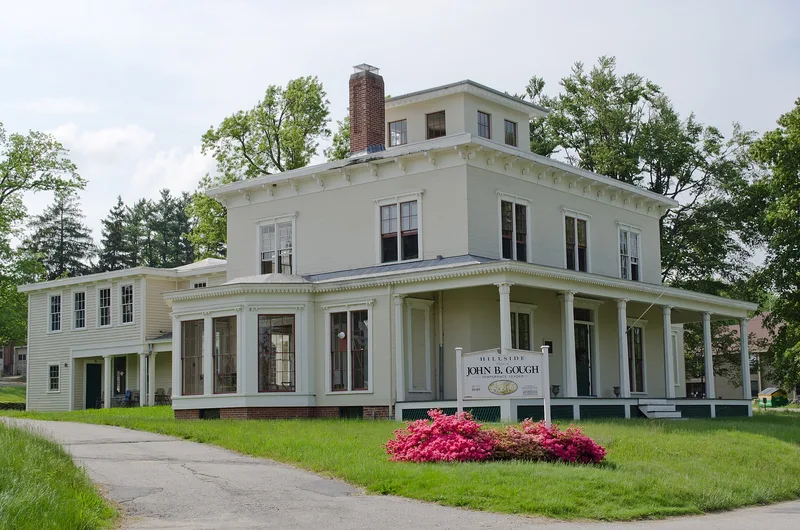
Hillside, the John B. Gough House in Boylston, Massachusetts, is a spacious white New England frame house of two stories with a hipped roof, a cupola, restrained Italianate bracketing and a front porch with octagonal columns. Gough had it built in 1848 for himself and his second wife, Mary Whitcomb, on twenty-six acres five miles from Worcester. He lived here until his death in 1886. Gough was a reformed drunkard who signed a temperance pledge in Worcester in 1842 and became one of the country's best-known temperance lecturers. He gave thousands of lectures in the United States and toured England several times. The house remains close to its appearance in an 1869 engraving, with the loss of its shutters the only noted alteration. A horse barn and a cart house/workshop also stand on the property. The estate was a working farm that employed twelve laborers by 1868. The house later held apartments, a school faculty residence, and a corporate training center before the town acquired it.
Significance in brief: Gough lived here from 1848 until his death in 1886, the major part of his career as a temperance orator. He lectured across the United States and in England, and the nomination argues that he was one of the movement's most spectacular reformers. The house is described as well preserved and largely unchanged from its appearance in Gough's time.
Machine-generated summary. This summary was generated by a language model from the official nomination document and has not been reviewed line by line by an editor. It may contain errors. Check the source document before relying on any detail. Source: nomination document (PDF) · National Archives catalog entry. NRHP reference 74001763, listed March 19, 1974. Summary generated October 2026 (model claude-sonnet-5-5, prompt v1.0-2026-10-29, confidence medium).
Key facts
| Address | 221 Main St., Boylston |
|---|---|
| County | Worcester County |
| Listed | March 19, 1974 |
| Reference number | 74001763 |
| Resource type | Building |
| Period of significance | 1848-1886 |
| Architectural style | Mid-19th Century: Italian Villa (restrained Italianate details) |
| Areas of significance | Social History |
| Level of significance | National |
| National Historic Landmark | Yes, designated May 30, 1974 |
| Status (as stated in the nomination) | The 1973 form lists the house as occupied, in excellent condition and unaltered, serving as a residence for teachers. The later documentation says the estate is owned by the Town of Boylston and is the subject of a restoration project begun in 1998. |
| Acreage | 0.9 |
| Coordinates | 42.32895, -71.75563 (NPS GIS) |
What listing means for this property
National Register listing is honorary for a privately owned home: it does not by itself restrict what an owner may do with their own money, and it does not require public access. Restrictions come from local landmark or historic-district ordinances, which are separate (how they differ).
Owner-occupied houses are not eligible for the 20% federal rehabilitation tax credit, which applies to income-producing buildings, but many states offer credits for homeowners. Listing also opens the door to preservation easements and to buying a plaque. Start with what listing means for homeowners, renovating a listed house and selling one.
General information, not legal or tax advice. Rules change; confirm with your State Historic Preservation Office or a qualified adviser.
Sources and further reading
- National Park Service, National Register of Historic Places database (snapshot May 2026), reference 74001763.
- Nomination form (PDF, National Archives) — catalog entry
- Wikipedia article (used for cross-checking only; text not reproduced here)
- Wikidata Q14715634
- This listing as JSON
Last updated October 2026. Found an error? See the editorial policy for how to report it.