Cambridge Grant Historic District
Also known as: Russell Hill
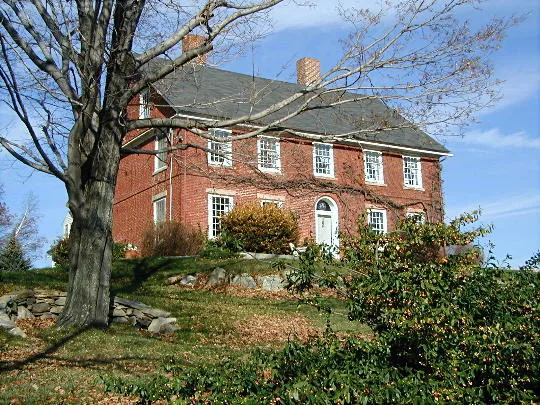

Why it's listed
Cambridge Grant Historic District is a 322-acre rural neighborhood on the southern and eastern slopes of Russell Hill in eastern Ashburnham, Massachusetts. It takes in a large part of a colonial land grant of just over 1,000 acres. Along Russell Hill Road and Wilker Road stand seven houses built between 1788 and 1834, together with six barns and other outbuildings, stone walls, a farm pond, a burial ground, a brick kiln site and the foundations of a tanning shop and an early schoolhouse. The Thomas Russell House is the oldest surviving dwelling in the grant. The brick John Adams, Jr. House, built about 1798, was the first brick house and the largest in town. Other Federal farmhouses and a large bank barn, possibly the earliest in the region, show how local builders adapted regional forms. The district retains open pasture, orchards and woodland with long views toward Boston, giving a well-preserved picture of an early farming community.
Significance in brief: The district preserves a largely unchanged rural New England farm landscape of Federal-period farmhouses, barns and open land. The houses include the oldest dwelling in the grant, the first brick house in town, and rare examples of local building types. The excerpt provided does not include the full Section 8 statement, so the stated criteria are not visible.
Machine-generated summary. This summary was generated by a language model from the official nomination document and has not been reviewed line by line by an editor. It may contain errors. Check the source document before relying on any detail. Source: nomination document (PDF) · National Archives catalog entry. NRHP reference 01000626, listed August 20, 2001. Summary generated October 2026 (model claude-sonnet-5-5, prompt v1.0-2026-10-29, confidence medium).
Key facts
| Address | 205-287 Russell Hill Rd., 15 Wilker Rd., Ashburnham |
|---|---|
| County | Worcester County |
| Listed | August 20, 2001 |
| Reference number | 01000626 |
| Resource type | District |
| Architect / builder | Thomas Russell (built the Thomas Russell House); Walter Russell Adams and Timothy Fletcher are named as owners of their houses. No architect is named. |
| Architectural style | Early Republic: Federal, vernacular; Mid 19th century: vernacular; Early 20th century: vernacular |
| Areas of significance | Architecture, Agriculture, Art, Exploration/Settlement, Performing Arts, Social History |
| Level of significance | Local |
| Status (as stated in the nomination) | Farmsteads remain in domestic and agricultural use with surrounding fields and woodland; the form lists no non-contributing structures in the description. |
| Acreage | 322 |
| Coordinates | 42.64524, -71.86402 (NPS GIS) |
What listing means for this property
This is a historic district. Buildings within its boundary are either contributing (they add to the district's significance) or non-contributing. Owners of contributing income-producing buildings can claim the 20% federal rehabilitation tax credit; homeowners should look at state credits. National Register districts impose no design review by themselves; a local historic district ordinance, if one exists, does (the difference explained).
General information, not legal or tax advice. Rules change; confirm with your State Historic Preservation Office or a qualified adviser.
Sources and further reading
- National Park Service, National Register of Historic Places database (snapshot May 2026), reference 01000626.
- Nomination form (PDF, National Archives) — catalog entry
- Wikipedia article (used for cross-checking only; text not reproduced here)
- Wikidata Q5025425
- This listing as JSON
Last updated October 2026. Found an error? See the editorial policy for how to report it.