Barton, Clara, Homestead

Why it's listed
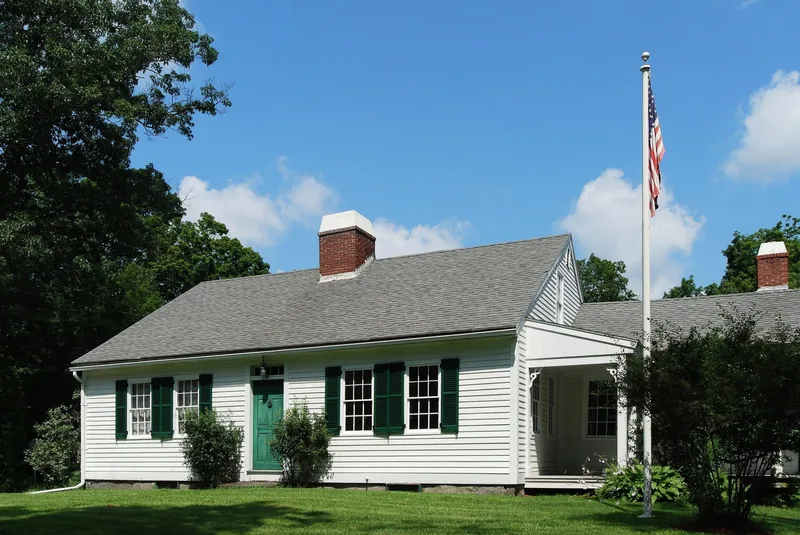
Clara Barton Homestead in Oxford, Massachusetts, is a simple Cape-style farmhouse built in 1818 by Captain Stephen Barton, a veteran of the Indian Campaigns. It has one and a half stories, a side-gabled ridge roof, a center chimney, a five-bay facade with a center entrance framed by an arched lattice trellis, and an internal well in the kitchen. The interior remains almost unchanged from Clara Barton's lifetime, apart from a small caretaker's apartment in a converted rear shed. A two-story shingled barn stands just east of the house. The property sits within a diabetic camp, surrounded by modern administration buildings and cabins. The house matters as the birthplace of Clara Barton, founder of the American Red Cross, who was born there on December 25, 1821 and lived there for thirty-two years before leaving for Bordentown, New Jersey. She later returned often. A women's Unitarian-Universalist federation acquired it in 1921 and keeps it as a museum with many original family furnishings.
Significance in brief: It is the birthplace of Clara Barton, founder of the American Red Cross, who was born there on December 25, 1821 and lived there for thirty-two years. Her father, Captain Stephen Barton, built it in 1818. The house is maintained as a museum and holds many original Barton family furnishings.
Machine-generated summary. This summary was generated by a language model from the official nomination document and has not been reviewed line by line by an editor. It may contain errors. Check the source document before relying on any detail. Source: nomination document (PDF) · National Archives catalog entry. NRHP reference 77000202, listed September 22, 1977. Summary generated October 2026 (model claude-sonnet-5-5, prompt v1.0-2026-10-29, confidence high).
Key facts
| Address | 3 mi. W of Oxford on Clara Barton Rd., Oxford |
|---|---|
| County | Worcester County |
| Listed | September 22, 1977 |
| Reference number | 77000202 |
| Resource type | Building |
| Period of significance | 1800-1899 |
| Architect / builder | Captain Stephen Barton |
| Architectural style | Cape |
| Areas of significance | Social History |
| Level of significance | National |
| Status (as stated in the nomination) | Occupied and in excellent to good condition; maintained as a museum house, with a small caretaker's apartment in a converted rear shed. The barn is used by the adjoining diabetic camp in summer. |
| Acreage | 0.8 |
| Coordinates | 42.15337, -71.89527 (NPS GIS) |
What listing means for this property
National Register listing is honorary for a privately owned home: it does not by itself restrict what an owner may do with their own money, and it does not require public access. Restrictions come from local landmark or historic-district ordinances, which are separate (how they differ).
Owner-occupied houses are not eligible for the 20% federal rehabilitation tax credit, which applies to income-producing buildings, but many states offer credits for homeowners. Listing also opens the door to preservation easements and to buying a plaque. Start with what listing means for homeowners, renovating a listed house and selling one.
General information, not legal or tax advice. Rules change; confirm with your State Historic Preservation Office or a qualified adviser.
Sources and further reading
- National Park Service, National Register of Historic Places database (snapshot May 2026), reference 77000202.
- Nomination form (PDF, National Archives) — catalog entry
- Wikipedia article (used for cross-checking only; text not reproduced here)
- Wikidata Q16890365
- This listing as JSON
Last updated October 2026. Found an error? See the editorial policy for how to report it.