Pinewoods Camp
Also known as: Pine Tree Camp

Why it's listed
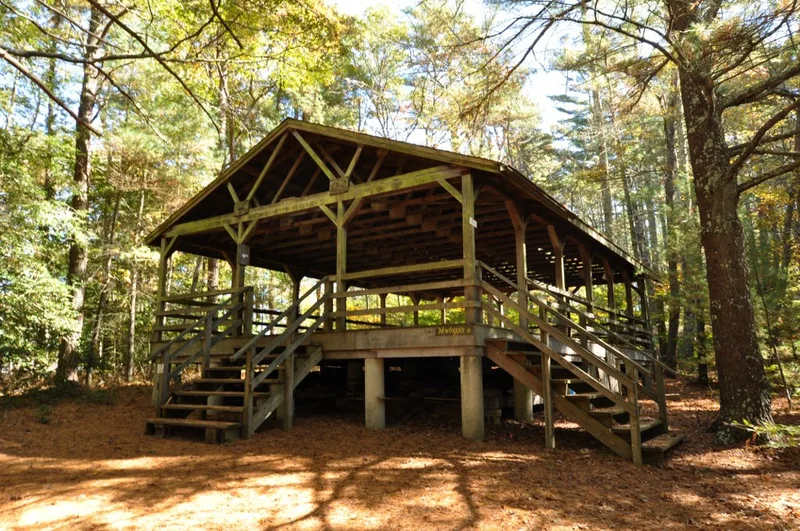
Pinewoods Camp occupies 31 acres of white pine woodland between Long Pond and Round Pond in Plymouth, Massachusetts. It began in 1919 as the First National Girl Scout Training Camp, with the first buildings arranged in a square above Long Pond. Cabins, outhouses and pavilions followed in clusters along the slopes, most of them small 12-foot-square wooden cabins with novelty siding and awning windows meant to recall canvas tent flaps. Helen Storrow, a supporter of the Girl Scouts and of English traditional dance, brought dance classes to the camp in the mid-1920s. In 1934 she offered it as a permanent home for the dance school, and from 1935 it was renamed Pinewoods Camp. Early twentieth-century cottages around Round Pond were bought and added as housing. About 62 of roughly 100 buildings date from 1919 to 1940. Newer buildings were designed to match the originals in materials and scale. The camp still operates as a dance and music facility, and it is listed as a district for its association with scouting and traditional dance.
Significance in brief: The camp was the first national Girl Scout training camp. From the mid-1920s, and permanently from 1935, it became a center for English and later American traditional dance, a use that continues. The nomination also values its intact rustic camp architecture and its natural setting, and notes high archaeological potential.
Machine-generated summary. This summary was generated by a language model from the official nomination document and has not been reviewed line by line by an editor. It may contain errors. Check the source document before relying on any detail. Source: nomination document (PDF) · National Archives catalog entry. NRHP reference 09001151, listed December 16, 2009. Summary generated October 2026 (model claude-sonnet-5-5, prompt v1.0-2026-10-29, confidence medium).
Key facts
| Address | 80 Cornish Field Rd., Plymouth |
|---|---|
| County | Plymouth County |
| Listed | December 16, 2009 |
| Reference number | 09001151 |
| Resource type | District |
| Architectural style | Late 19th and Early 20th Century American Movements: Bungalow/Craftsman |
| Areas of significance | Architecture, Community Planning and Development, Entertainment/Recreation, Performing Arts |
| Level of significance | State, Local |
| Status (as stated in the nomination) | Still in use as a dance and music camp; about 62 of 100 buildings date from 1919-1940 and are described as intact and in good condition. |
| Acreage | 31 |
| Coordinates | 41.85381, -70.60143 (NPS GIS) |
What listing means for this property
This is a historic district. Buildings within its boundary are either contributing (they add to the district's significance) or non-contributing. Owners of contributing income-producing buildings can claim the 20% federal rehabilitation tax credit; homeowners should look at state credits. National Register districts impose no design review by themselves; a local historic district ordinance, if one exists, does (the difference explained).
General information, not legal or tax advice. Rules change; confirm with your State Historic Preservation Office or a qualified adviser.
Sources and further reading
- National Park Service, National Register of Historic Places database (snapshot May 2026), reference 09001151.
- Nomination form (PDF, National Archives) — catalog entry
- Wikipedia article (used for cross-checking only; text not reproduced here)
- Wikidata Q7195603
- This listing as JSON
Last updated October 2026. Found an error? See the editorial policy for how to report it.