Stoneholm
Also known as: The Lothrop House

Why it's listed
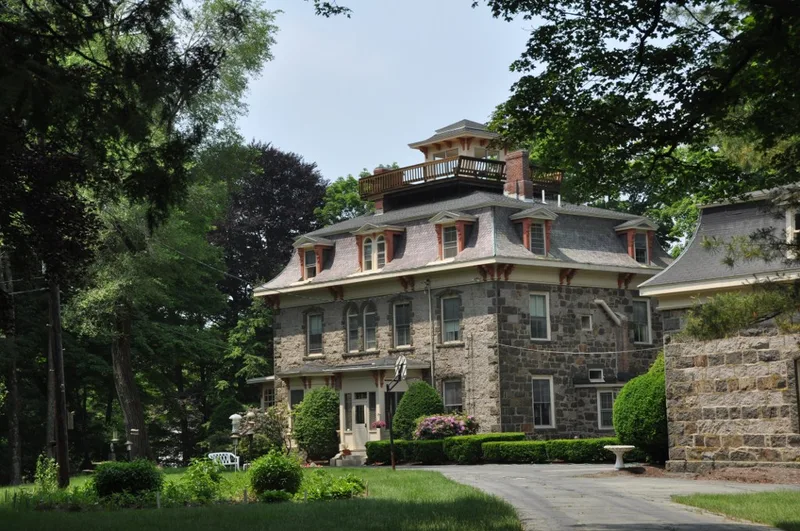
Built in 1864 at 188 Ames Street in Sharon, Massachusetts, Stoneholm is a two-and-one-half-story Second Empire house of locally quarried, rock-faced granite ashlar. It has a slate mansard roof laid in a hexagonal pattern, a cupola, bracketed wooden porches and darker granite quoins and window trim. A granite carriage house with its own mansard roof stands on the 2.73-acre property, which is bordered by trees. The house was built for Horace A. Lothrop (1828-1898), who came to Sharon in 1847 and helped run a cutlery factory that kept its workers employed through business downturns. He later co-founded a shoe-shank firm, founded the Niantic Hose Company, served in the state legislature and on the school board, and gave to the public library, street lighting and shade trees. The nomination calls the house a unique local example of its style, remaining largely unaltered. Two stone-lined chambers under the front lawn are believed to have produced gas for lighting and heating.
Significance in brief: The nomination argues the house is a unique local example of Second Empire architecture that remains essentially unaltered, with fine stonework. It is also tied to Horace A. Lothrop, Sharon's leading industrialist of the mid-nineteenth century. Two stone-lined chambers beneath the front lawn are believed to have supplied gas for lighting and heating.
Machine-generated summary. This summary was generated by a language model from the official nomination document and has not been reviewed line by line by an editor. It may contain errors. Check the source document before relying on any detail. Source: nomination document (PDF) · National Archives catalog entry. NRHP reference 80000648, listed April 2, 1980. Summary generated October 2026 (model claude-sonnet-5-5, prompt v1.0-2026-10-29, confidence high).
Key facts
| Address | 188 Ames St., Sharon |
|---|---|
| County | Norfolk County |
| Listed | April 2, 1980 |
| Reference number | 80000648 |
| Resource type | Building |
| Period of significance | 1800-1899 |
| Architect / builder | Architect Unknown |
| Architectural style | Second Empire |
| Areas of significance | Industry, Politics/Government, Architecture |
| Level of significance | Local |
| Status (as stated in the nomination) | Described as unaltered and in good condition, on its original site, and occupied; the carriage house has only minor alterations such as asphalt shingles replacing slates. |
| Acreage | 2.7 |
| Coordinates | 42.11527, -71.16539 (NPS GIS) |
What listing means for this property
National Register listing is honorary: it recognises significance and does not restrict what a private owner may do without federal money or permits. It unlocks the 20% federal rehabilitation tax credit for income-producing buildings, state credits in many states, and Section 106 review when federal agencies are involved. See what listing means in practice.
General information, not legal or tax advice. Rules change; confirm with your State Historic Preservation Office or a qualified adviser.
Sources and further reading
- National Park Service, National Register of Historic Places database (snapshot May 2026), reference 80000648.
- Nomination form (PDF, National Archives) — catalog entry
- Wikipedia article (used for cross-checking only; text not reproduced here)
- Wikidata Q7619230
- This listing as JSON
Last updated October 2026. Found an error? See the editorial policy for how to report it.