Sea Street Historic District

Why it's listed
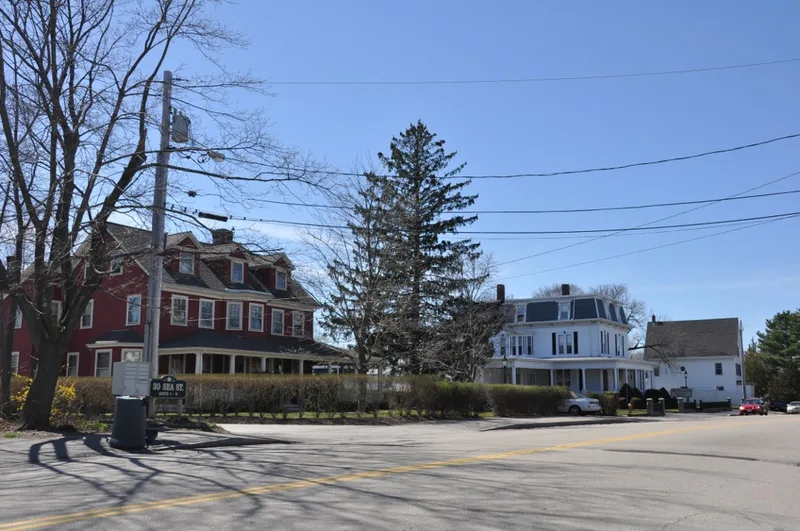
Sea Street Historic District covers roughly 49 acres in North Weymouth, Massachusetts, around the junction of North, Sea and Bridge streets. Its 156 resources include 120 contributing and 36 noncontributing ones, mostly modest wood-frame houses, with Beals Park as the central open space. Buildings range from a Cape-style cottage said to date to 1650 through Federal, Greek Revival, Italianate, Mansard and bungalow houses. Institutional buildings include the Greek Revival Pilgrim Congregational Church of 1852, the Gothic Revival Third Universalist Church, two brick schools and a 1954 modernist library. Most development came between the mid-19th and early 20th centuries, when shoemaking drove the village's growth. Four domestic-scaled shoe factories survive, including the one built by Elias S. Beals, an early user of the sole-sewing machine. Artificial siding has affected some buildings, but the district keeps the best surviving historic architecture and the village's historic character.
Significance in brief: The district is the most intact and cohesive grouping of historic buildings in the North Weymouth village center. It reflects about 300 years of local history, especially the mid-19th to early 20th century when small-scale shoemaking flourished. It preserves shoe factories, houses, churches, schools and a park from successive periods of village growth.
Machine-generated summary. This summary was generated by a language model from the official nomination document and has not been reviewed line by line by an editor. It may contain errors. Check the source document before relying on any detail. Source: nomination document (PDF) · National Archives catalog entry. NRHP reference 09000646, listed August 19, 2009. Summary generated October 2026 (model claude-sonnet-5-5, prompt v1.0-2026-10-29, confidence medium).
Key facts
| Address | Roughly bounded by Bridge, North, Neck Sts., Crescent Rd., Pearl St. and rear of Standish St., Weymouth |
|---|---|
| County | Norfolk County |
| Listed | August 19, 2009 |
| Reference number | 09000646 |
| Resource type | District |
| Period of significance | ca. 1650-ca. 1959 |
| Architect / builder | Loring & Phipps (Athens School); J. Williams Beal & Sons (Bicknell School); Carl Koch (Tufts Library) |
| Architectural style | Colonial, Federal, Greek Revival, Gothic Revival, Italianate, Second Empire, Queen Anne, Colonial Revival, Classical Revival, Bungalow/Craftsman, Moderne, International |
| Areas of significance | Architecture, Commerce, Industry, Entertainment/Recreation, Social History |
| Level of significance | Local |
| Status (as stated in the nomination) | Most buildings remain in residential use. Four surviving shoe factories have been converted to residential use. Condition ranges from fair to excellent, with artificial siding the main alteration. |
| Acreage | 49 |
| Coordinates | 42.23993, -70.94666 (NPS GIS) |
What listing means for this property
This is a historic district. Buildings within its boundary are either contributing (they add to the district's significance) or non-contributing. Owners of contributing income-producing buildings can claim the 20% federal rehabilitation tax credit; homeowners should look at state credits. National Register districts impose no design review by themselves; a local historic district ordinance, if one exists, does (the difference explained).
General information, not legal or tax advice. Rules change; confirm with your State Historic Preservation Office or a qualified adviser.
Sources and further reading
- National Park Service, National Register of Historic Places database (snapshot May 2026), reference 09000646.
- Nomination form (PDF, National Archives) — catalog entry
- Wikipedia article (used for cross-checking only; text not reproduced here)
- Wikidata Q16899892
- This listing as JSON
Last updated October 2026. Found an error? See the editorial policy for how to report it.