Salem Lutheran Church

Why it's listed
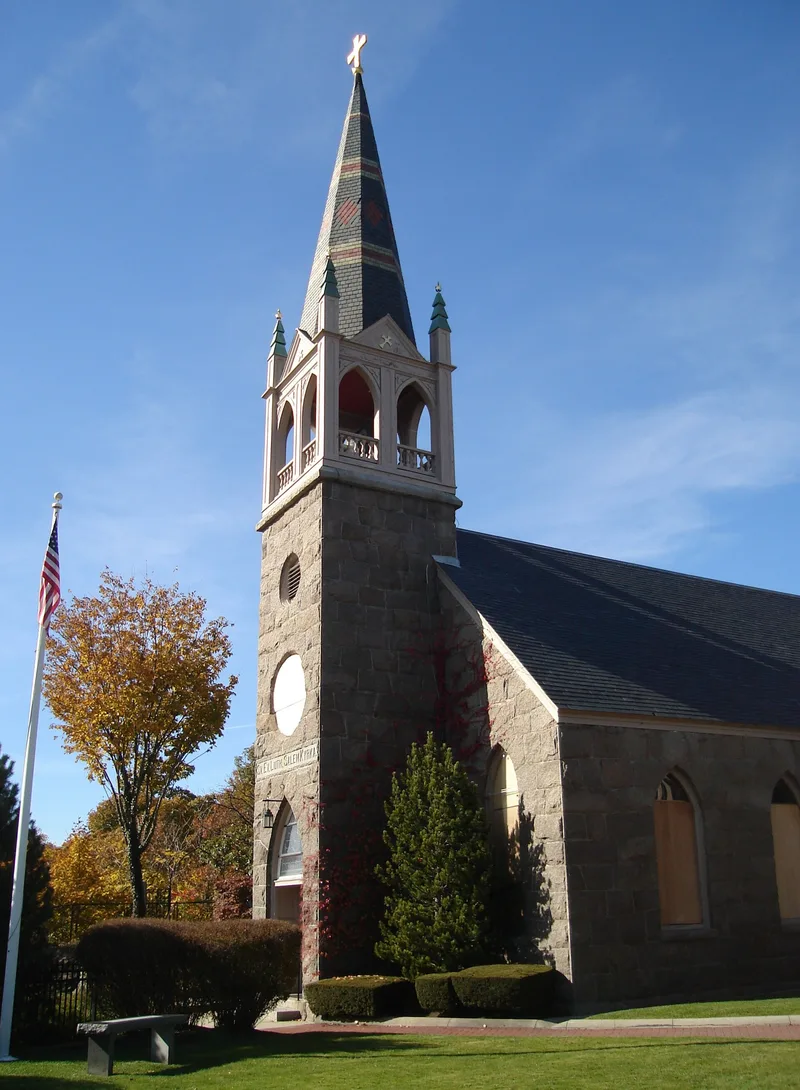
Salem Lutheran Church sits on a granite outcropping at 199 Granite Street in Quincy, with a view over South and West Quincy. The cornerstone dates the original building to 1892, and a chapel was added in 1914. Its rough granite walls, gabled roof, and square front tower with a pointed-arch entrance, lancet windows, an open belfry, and an octagonal wooden spire make it one of Quincy's two best 19th-century granite Gothic Revival churches. The congregation began in 1889 as the Swedish Evangelical Lutheran Salem Church, formed by Scandinavian immigrants who came to work in the West Quincy granite industry. Members met in Christ Church's chapel and in Plummer's Hall before buying the rock ledge in 1891. Church historians recall that the congregation's men quarried stone locally and built the church themselves. It was dedicated in 1894. The church is valued for its architecture and its link to Quincy's immigrant and quarrying history, and it remains well preserved.
Significance in brief: The nomination presents it as a well-preserved example of vernacular Gothic Revival church architecture and one of Quincy's two best 19th-century granite Gothic Revival churches. It is also associated with the Scandinavian, primarily Swedish, immigrants who came to work in West Quincy's granite industry.
Machine-generated summary. This summary was generated by a language model from the official nomination document and has not been reviewed line by line by an editor. It may contain errors. Check the source document before relying on any detail. Source: nomination document (PDF) · National Archives catalog entry. NRHP reference 89001341, listed September 20, 1989. Summary generated October 2026 (model claude-sonnet-5-5, prompt v1.0-2026-10-29, confidence medium).
Key facts
| Address | 199 Granite St., Quincy |
|---|---|
| County | Norfolk County |
| Listed | September 20, 1989 |
| Reference number | 89001341 |
| Resource type | Building |
| Architectural style | Gothic Revival |
| Criteria |
|
| Areas of significance | Community Planning and Development, Architecture |
| Level of significance | Local |
| Status (as stated in the nomination) | Condition is described as good; the building is listed with a present use as a church. |
| Acreage | 0.3 |
| Coordinates | 42.24493, -71.00838 (NPS GIS) |
What listing means for this property
Religious properties are listed for their architectural or historical significance, not their religious use. Listing is honorary and does not restrict the congregation's use of the building. The federal rehabilitation credit is generally unavailable unless part of the building is income-producing; some state programmes and preservation grants do cover religious buildings. Federal funding or permits trigger Section 106 review.
General information, not legal or tax advice. Rules change; confirm with your State Historic Preservation Office or a qualified adviser.
Sources and further reading
- National Park Service, National Register of Historic Places database (snapshot May 2026), reference 89001341.
- Nomination form (PDF, National Archives) — catalog entry
- Wikipedia article (used for cross-checking only; text not reproduced here)
- Wikidata Q5431203
- This listing as JSON
Last updated October 2026. Found an error? See the editorial policy for how to report it.