Roebuck Tavern

Why it's listed
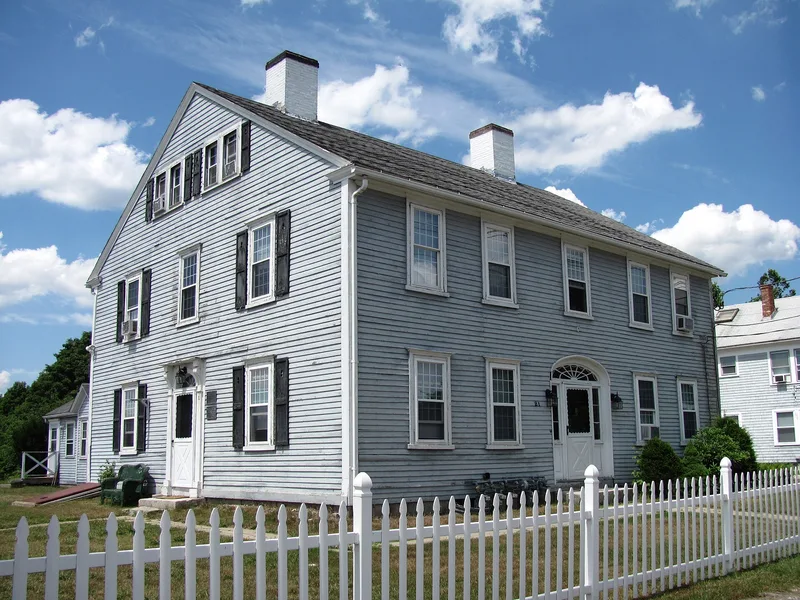
Built about 1795 for David Fisher and his family, this two-story, five-bay clapboard building at 21 Dedham Street sits in the historic center of Wrentham. Its symmetrical south facade has a center entry with sidelights and an elliptical fanlight, twin interior chimneys, 12/12 sash windows and a granite foundation. A one-story ell was added in two stages during the 19th century. The property stood on the Boston/Providence Turnpike, which opened early in the 1800s and spurred growth in town. Over time the building served as a tavern, inn, post office, toll collector's house and family home, and it kept operating as an inn and tavern into the early 20th century. The Fisher family, early settlers and town selectmen, owned it until 1910. George Fisher, a grandson of the first owner, became a professor and dean at Yale Divinity School. Listing recognizes its Federal detailing, its integrity, and its role in the town's commercial development.
Significance in brief: The nomination argues the building is one of Wrentham's best preserved examples of residential Federal architecture. It is tied to the growth of Wrentham Center after the Boston/Providence Turnpike opened in the early 19th century. It is also linked to the prominent Fisher family, who owned it until 1910. It was documented by HABS in 1937.
Machine-generated summary. This summary was generated by a language model from the official nomination document and has not been reviewed line by line by an editor. It may contain errors. Check the source document before relying on any detail. Source: nomination document (PDF) · National Archives catalog entry. NRHP reference 84002878, listed May 17, 1984. Summary generated October 2026 (model claude-sonnet-5-5, prompt v1.0-2026-10-29, confidence high).
Key facts
| Address | 21 Dedham St., Wrentham |
|---|---|
| County | Norfolk County |
| Listed | May 17, 1984 |
| Reference number | 84002878 |
| Resource type | Building |
| Period of significance | 1700-1799 and 1800-1899 (specific date ca. 1795) |
| Architectural style | Federal |
| Criteria |
|
| Areas of significance | Commerce, Architecture |
| Level of significance | Local |
| Status (as stated in the nomination) | Condition listed as good and altered, on its original site; the form notes it was used as a tavern into the early 20th century and that original outbuildings no longer stand. |
| Acreage | 0.3 |
| Coordinates | 42.06751, -71.32742 (NPS GIS) |
What listing means for this property
For an income-producing building, listing (individually or as a contributing building in a district) is the gateway to the 20% federal rehabilitation tax credit on qualified rehabilitation costs, often stackable with state credits. Work claiming the credit must follow the Secretary of the Interior's Standards and be approved in advance.
Listing does not restrict a private owner acting without federal money or permits; where federal funding or licensing is involved, Section 106 review applies.
General information, not legal or tax advice. Rules change; confirm with your State Historic Preservation Office or a qualified adviser.
Sources and further reading
- National Park Service, National Register of Historic Places database (snapshot May 2026), reference 84002878.
- Nomination form (PDF, National Archives) — catalog entry
- Wikipedia article (used for cross-checking only; text not reproduced here)
- Wikidata Q7357556
- This listing as JSON
Last updated October 2026. Found an error? See the editorial policy for how to report it.