Railway Village Historic District
Also known as: East Milton Historic District

Why it's listed
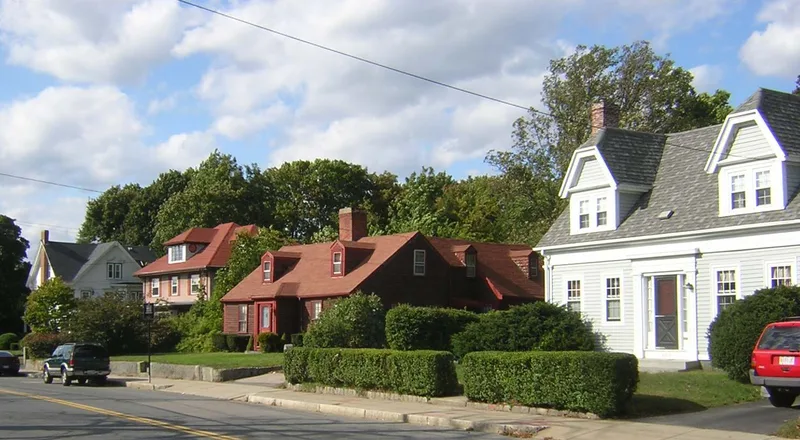
Railway Village is a compact residential neighborhood of about 30 acres in East Milton, Massachusetts, just south of Boston. Centered on Adams Street, it holds 191 resources, including 189 buildings, a site and a structure, and 177 of the buildings plus the site and structure contribute to its character. The oldest house, built in 1748 for Lancelot Pierce, sits at the eastern end of Adams Street. Most homes are modest wood-frame houses, with many Greek Revival examples from the 1830s to 1860s and a large group from 1870 to 1915, alongside stables, garages and a Colonial Revival church. Crane Field and a system of stone walls and granite posts along Adams Street also contribute. The neighborhood grew after the Granite Railway and then the Old Colony Railroad brought quarry traffic and commuters, as farmland was subdivided for housing. Local carpenters such as Samuel Marden and Oren Bates built key houses, and later developers like Albert Brackett added whole streets. The period of significance runs from 1748 to 1949.
Significance in brief: The district shows how a sparsely settled 18th-century farming landscape became a 19th-century village, spurred first by the Granite Railway and later the Old Colony Railroad. It keeps a wide range of house styles from Colonial to Craftsman, along with stables, garages, stone walls and a public field. The nomination ties its growth to the granite quarrying and railroad community shared with West Quincy.
Machine-generated summary. This summary was generated by a language model from the official nomination document and has not been reviewed line by line by an editor. It may contain errors. Check the source document before relying on any detail. Source: nomination document (PDF) · National Archives catalog entry. NRHP reference 00000111, listed March 6, 2000. Summary generated October 2026 (model claude-sonnet-5-5, prompt v1.0-2026-10-29, confidence medium).
Key facts
| Address | Roughly along Adams St., from Mechanic and Church Sts., and Washington St., Milton |
|---|---|
| County | Norfolk County |
| Listed | March 6, 2000 |
| Reference number | 00000111 |
| Resource type | District |
| Period of significance | 1748-1949 |
| Architect / builder | Carpenters Samuel Marden and Oren Bates are named as builders of key houses; Boston architect Charles Hall designed the demolished Railway Meeting House, built by Samuel Marden. |
| Architectural style | Colonial, Greek Revival, Italianate, Queen Anne, Victorian Eclectic, Colonial Revival, Craftsman |
| Areas of significance | Health/Medicine, Architecture, Community Planning and Development |
| Level of significance | Local |
| Status (as stated in the nomination) | Dwellings described as in good condition; about 40% have synthetic siding, and two buildings are noncontributing because of remodeling. Most buildings remain residential. |
| Acreage | 30 |
| Coordinates | 42.25849, -71.03558 (NPS GIS) |
What listing means for this property
This is a historic district. Buildings within its boundary are either contributing (they add to the district's significance) or non-contributing. Owners of contributing income-producing buildings can claim the 20% federal rehabilitation tax credit; homeowners should look at state credits. National Register districts impose no design review by themselves; a local historic district ordinance, if one exists, does (the difference explained).
General information, not legal or tax advice. Rules change; confirm with your State Historic Preservation Office or a qualified adviser.
Sources and further reading
- National Park Service, National Register of Historic Places database (snapshot May 2026), reference 00000111.
- Nomination form (PDF, National Archives) — catalog entry
- Wikipedia article (used for cross-checking only; text not reproduced here)
- Wikidata Q7284218
- This listing as JSON
Last updated October 2026. Found an error? See the editorial policy for how to report it.