Winchester Center Historic District
Also known as: See Also:Winchester Town Hall; Winchester Savings Bank

Why it's listed
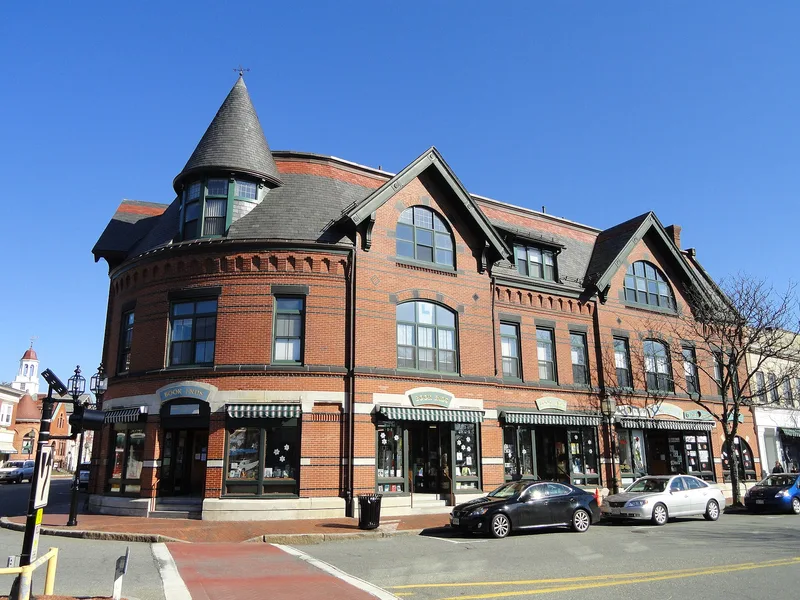
Winchester Center is the commercial and civic heart of a Boston suburb, a district of about 40 acres on flat ground along the Aberjona River. It includes 56 contributing buildings, three parks and two historic bridges, lining Main, Church and Mount Vernon Streets. The area was first settled by Europeans around 1640 and grew rapidly after the Boston & Lowell Railroad arrived in 1835, leading to the town's separation from Woburn in 1850. Buildings range from Greek Revival houses and the 1854 First Congregational Church to the Queen Anne Brown & Stanton Block of 1879, the 1903 Beaux Arts high school, the 1914 police and fire stations, the 1931 Gothic Revival library and the 1935-1936 Colonial Revival Locatelli Building. The district was listed for its architecture and its record of the town's commercial, institutional and residential growth between 1835 and 1935. Mill sites along the river also suggest archaeological potential.
Significance in brief: The district is argued to be an exceptionally well-preserved example of an affluent Boston suburb, with an eclectic and well-designed mix of buildings and landscaped parks. It reflects the town's commercial, institutional and residential development over the 100 years following its 1850 incorporation. It also keeps some features of its earlier settlement and has archaeological potential.
Machine-generated summary. This summary was generated by a language model from the official nomination document and has not been reviewed line by line by an editor. It may contain errors. Check the source document before relying on any detail. Source: nomination document (PDF) · National Archives catalog entry. NRHP reference 86002943, listed November 21, 1986. Summary generated October 2026 (model claude-sonnet-5-5, prompt v1.0-2026-10-29, confidence high).
Key facts
| Address | Roughly bounded by Mt. Vernon and Washington Sts., Waterfield Rd., Church and Main Sts., Winchester |
|---|---|
| County | Middlesex County |
| Listed | November 21, 1986 |
| Reference number | 86002943 |
| Resource type | District |
| Period of significance | 1835-1935 |
| Architect / builder | see text (individual buildings name Robert Coit, architect of the 1931 Public Library) |
| Architectural style | Varied, from Greek Revival and Italianate to Queen Anne, Classical Revival, Colonial Revival, Georgian Revival, Gothic Revival and Beaux Arts |
| Criteria |
|
| Areas of significance | Community Planning and Development, Commerce, Architecture |
| Level of significance | Local |
| Status (as stated in the nomination) | Generally in good condition; most buildings retain original features such as entries, window surrounds and cornices. Some buildings have been altered, and 14 structures are noncontributing. |
| Acreage | 40 |
| Coordinates | 42.45184, -71.13628 (NPS GIS) |
What listing means for this property
This is a historic district. Buildings within its boundary are either contributing (they add to the district's significance) or non-contributing. Owners of contributing income-producing buildings can claim the 20% federal rehabilitation tax credit; homeowners should look at state credits. National Register districts impose no design review by themselves; a local historic district ordinance, if one exists, does (the difference explained).
General information, not legal or tax advice. Rules change; confirm with your State Historic Preservation Office or a qualified adviser.
Sources and further reading
- National Park Service, National Register of Historic Places database (snapshot May 2026), reference 86002943.
- Nomination form (PDF, National Archives) — catalog entry
- Wikipedia article (used for cross-checking only; text not reproduced here)
- Wikidata Q8023784
- This listing as JSON
Last updated October 2026. Found an error? See the editorial policy for how to report it.