West Newton Hill Historic District

Why it's listed
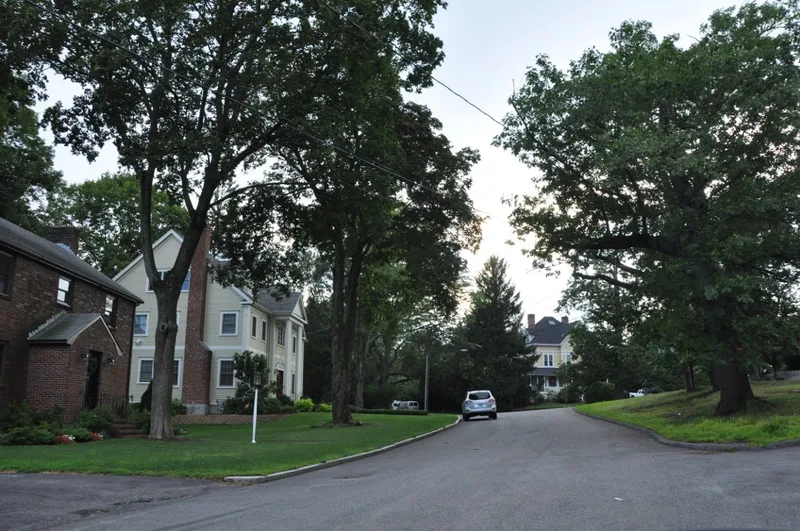
West Newton Hill Historic District is a 36-acre residential neighborhood of large single-family houses on the summit and north slope of a hill in Newton, Massachusetts. It contains 73 buildings and a small bronze fountain installed in 1903. Most of the 58 contributing houses went up between 1880 and 1900 in the Queen Anne, Shingle and Colonial Revival styles, on generous lots. The hill was wooded and nearly empty until streets were laid out after the railroad arrived in the 1830s and 1840s. Developers then subdivided the land as Sylvan Heights, and later builders opened Regent, Lenox and Valentine streets. The district matters as a record of West Newton's growth into a fashionable suburb for Boston businessmen and as a collection of high-style period architecture. Notable pieces include the 1887 Queen Anne house by Bertrand Taylor at 304 Otis Street and a group of Shingle Style houses on Lenox Street.
Significance in brief: The district is argued to be a cohesive grouping of high-style Queen Anne, Shingle Style and Colonial Revival houses. It shows West Newton's growth as a fashionable suburb for Boston businessmen, many prominent in Newton's social and political life. It meets criteria A, B and C.
Machine-generated summary. This summary was generated by a language model from the official nomination document and has not been reviewed line by line by an editor. It may contain errors. Check the source document before relying on any detail. Source: nomination document (PDF) · National Archives catalog entry. NRHP reference 86001766, listed September 4, 1986. Summary generated October 2026 (model claude-sonnet-5-5, prompt v1.0-2026-10-29, confidence medium).
Key facts
| Address | Roughly bounded by Highland Ave., Lenox, Hampshire, and Chestnut Sts., Newton |
|---|---|
| County | Middlesex County |
| Listed | September 4, 1986 |
| Reference number | 86001766 |
| Resource type | District |
| Period of significance | 1860-1910 |
| Architect / builder | Bertrand Taylor (304 Otis Street); Eugene L. Clark (82 Lenox Street); Willard Sears (builder of 274 Otis Street); Edward Leland (developer-builder of Otis Street houses); Anne Whitney (sculptor of the Lambert Fountain) |
| Architectural style | Queen Anne, Shingle Style and Colonial Revival, with some Italianate, Mansard, Stick Style and Richardsonian Romanesque examples |
| Criteria |
|
| Areas of significance | Community Planning and Development, Architecture, Social History |
| Level of significance | State, Local |
| Status (as stated in the nomination) | Present use residential; general condition stated as good. Fifteen of the buildings are non-contributing because of post-1907 construction. |
| Acreage | 35.9 |
| Coordinates | 42.34354, -71.22068 (NPS GIS) |
What listing means for this property
This is a historic district. Buildings within its boundary are either contributing (they add to the district's significance) or non-contributing. Owners of contributing income-producing buildings can claim the 20% federal rehabilitation tax credit; homeowners should look at state credits. National Register districts impose no design review by themselves; a local historic district ordinance, if one exists, does (the difference explained).
General information, not legal or tax advice. Rules change; confirm with your State Historic Preservation Office or a qualified adviser.
Sources and further reading
- National Park Service, National Register of Historic Places database (snapshot May 2026), reference 86001766.
- Nomination form (PDF, National Archives) — catalog entry
- Wikipedia article (used for cross-checking only; text not reproduced here)
- Wikidata Q7986076
- This listing as JSON
Last updated October 2026. Found an error? See the editorial policy for how to report it.