Somerville Theatre
Also known as: Hobbs Building

Why it's listed
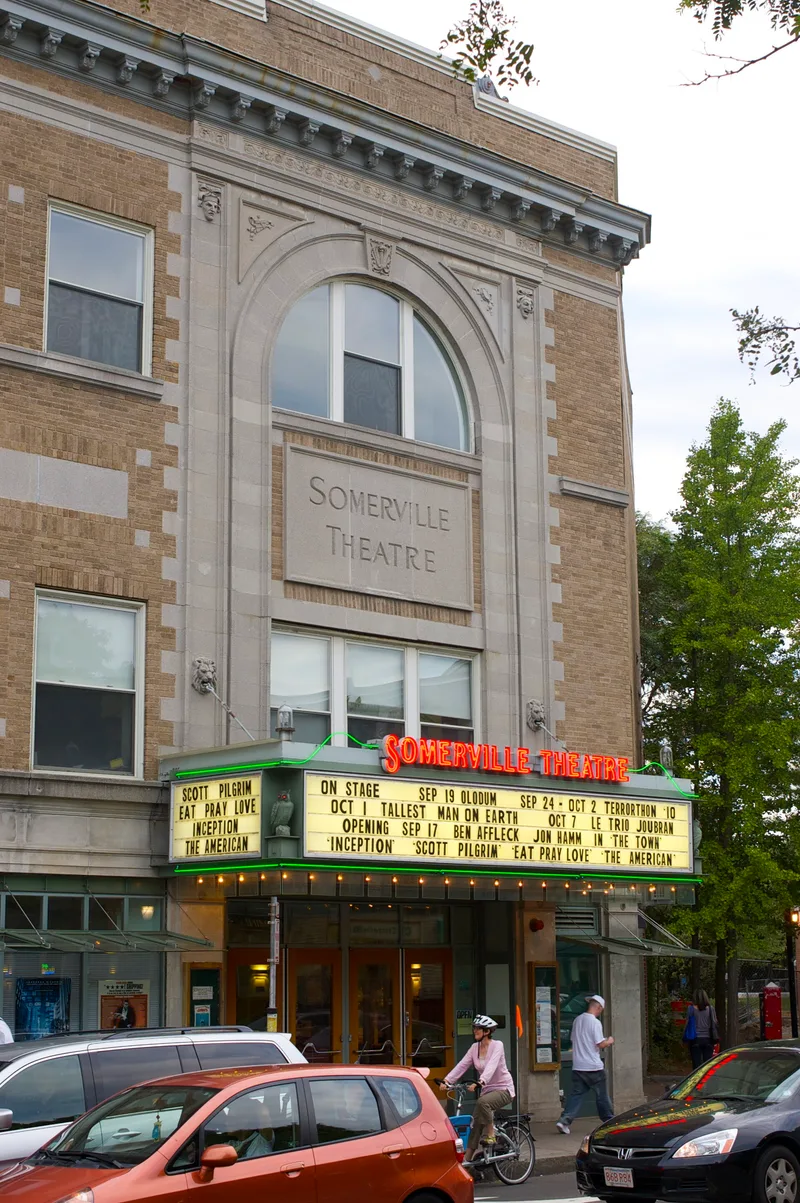
Built in 1914 at 55 Davis Square, this three-story brick and stone building housed a theatre along with a bowling alley, cafe, shops, offices and meeting rooms. Joseph O. Hobbs, a local businessman, commissioned it, and the architects Funk and Wilcox later used it as a prototype for Dorchester's Strand Theatre. It is the only surviving vaudeville-era theatre in Somerville and the oldest Boston-area theatre built explicitly as a movie house. Its opening year featured silent films with vaudeville, and in 1915 it became a stock theatre, where Busby Berkeley worked and Tallulah Bankhead and Kate Smith appeared. In 1932 it returned to motion pictures, and it has remained in use since. The interior retains a balcony with original brocade panels, a decorative scheme with Art Deco and Aztec geometric motifs likely added in 1932, and strong acoustics. Its significance is local, tied to Davis Square's growth as a streetcar suburb and to its long cultural role.
Significance in brief: The nomination argues it is the sole surviving vaudeville-era theatre in Somerville and a neighborhood cultural resource in continuous use since 1914. It reflects the suburbanization of Davis Square and the shift from silent movies and vaudeville to stock theatre, then films and concerts. It is also an example of an early 20th century vaudeville theatre with a notable Art Deco and Aztec-inspired interior.
Machine-generated summary. This summary was generated by a language model from the official nomination document and has not been reviewed line by line by an editor. It may contain errors. Check the source document before relying on any detail. Source: nomination document (PDF) · National Archives catalog entry. NRHP reference 89002330, listed January 26, 1990. Summary generated October 2026 (model claude-sonnet-5-5, prompt v1.0-2026-10-29, confidence high).
Key facts
| Address | 55 Davis Sq., Somerville |
|---|---|
| County | Middlesex County |
| Listed | January 26, 1990 |
| Reference number | 89002330 |
| Resource type | Building |
| Period of significance | 1914-1939 |
| Architect / builder | Funk and Wilcox |
| Architectural style | Neo-classical Revival |
| Criteria |
|
| Areas of significance | Community Planning and Development, Entertainment/Recreation, Commerce, Performing Arts, Architecture |
| Level of significance | Local |
| Status (as stated in the nomination) | Continuously in use as a theatre since 1914, with some shops and offices; exterior and interior are altered but described as not irreversibly so, and the interior is called sadly neglected. |
| Acreage | 0.9 |
| Coordinates | 42.39686, -71.12306 (NPS GIS) |
What listing means for this property
For an income-producing building, listing (individually or as a contributing building in a district) is the gateway to the 20% federal rehabilitation tax credit on qualified rehabilitation costs, often stackable with state credits. Work claiming the credit must follow the Secretary of the Interior's Standards and be approved in advance.
Listing does not restrict a private owner acting without federal money or permits; where federal funding or licensing is involved, Section 106 review applies.
General information, not legal or tax advice. Rules change; confirm with your State Historic Preservation Office or a qualified adviser.
Sources and further reading
- National Park Service, National Register of Historic Places database (snapshot May 2026), reference 89002330.
- Nomination form (PDF, National Archives) — catalog entry
- Wikipedia article (used for cross-checking only; text not reproduced here)
- Wikidata Q7559987
- This listing as JSON
Last updated October 2026. Found an error? See the editorial policy for how to report it.