Saint John's Episcopal Church
Also known as: Ecumenical Center,Framingham State College

Why it's listed
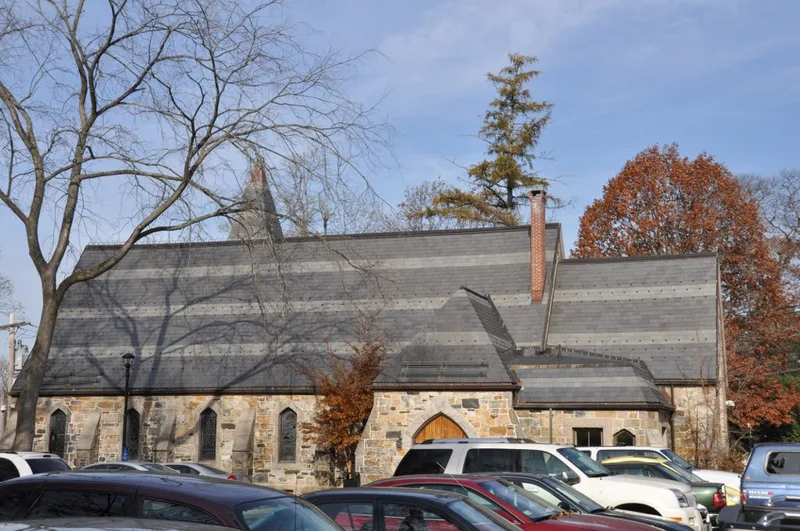
Rising from the western slope of Bare Hill in Framingham Centre, this stone church was built between 1869 and 1871 for the town's first Episcopal congregation. Architect Alexander Rice Esty, a parish founder and longtime Junior Warden, designed it in the manner of an English country church. Walls are coursed Framingham granite in shades of yellow-brown and gray, topped by a steep slate roof in alternating dark and light bands. An asymmetrical plan groups a narthex tower with a pyramidal spire, a transept arm and a vestry around the nave and chancel. Inside are exposed trusses, engaged columns, walnut pews and stained glass windows. The congregation closed the church in 1934, and Framingham State College bought it in 1969 and used it as an interdenominational Ecumenical Center until 1985, when it was closed for deterioration. The building is valued for its link to Framingham's growth and as a little-altered work by a well-known architect.
Significance in brief: The church is tied to Framingham's development as the first Episcopal church in town and the fourth oldest surviving church building there. It is a nearly unaltered example of Gothic Revival design by Alexander Esty, a nationally known Framingham architect. Its banded slate roof and picturesque tower also anticipate High Victorian Gothic.
Machine-generated summary. This summary was generated by a language model from the official nomination document and has not been reviewed line by line by an editor. It may contain errors. Check the source document before relying on any detail. Source: nomination document (PDF) · National Archives catalog entry. NRHP reference 89002300, listed January 12, 1990. Summary generated October 2026 (model claude-sonnet-5-5, prompt v1.0-2026-10-29, confidence medium).
Key facts
| Address | Maynard Rd. and Church St., Framingham |
|---|---|
| County | Middlesex County |
| Listed | January 12, 1990 |
| Reference number | 89002300 |
| Resource type | Building |
| Period of significance | 1869-1934 |
| Architect / builder | Esty, Alexander Rice |
| Architectural style | Mid-19th Century/Gothic Revival |
| Criteria |
|
| Areas of significance | Community Planning and Development, Architecture, Religion |
| Level of significance | Local |
| Status (as stated in the nomination) | Closed for deterioration reasons in 1985; the function section lists it as vacant/not in use. |
| Acreage | 0.9 |
| Coordinates | 42.29746, -71.43862 (NPS GIS) |
What listing means for this property
Religious properties are listed for their architectural or historical significance, not their religious use. Listing is honorary and does not restrict the congregation's use of the building. The federal rehabilitation credit is generally unavailable unless part of the building is income-producing; some state programmes and preservation grants do cover religious buildings. Federal funding or permits trigger Section 106 review.
Noted as vacant in the nomination. Nomination documents can be decades old; current status may differ. If you are considering buying an empty listed property, read the due-diligence checklist.
General information, not legal or tax advice. Rules change; confirm with your State Historic Preservation Office or a qualified adviser.
Sources and further reading
- National Park Service, National Register of Historic Places database (snapshot May 2026), reference 89002300.
- Nomination form (PDF, National Archives) — catalog entry
- Wikipedia article (used for cross-checking only; text not reproduced here)
- Wikidata Q7588685
- This listing as JSON
Last updated October 2026. Found an error? See the editorial policy for how to report it.