Newton Theological Institution Historic District
Also known as: See Also:Colby Hall

Why it's listed
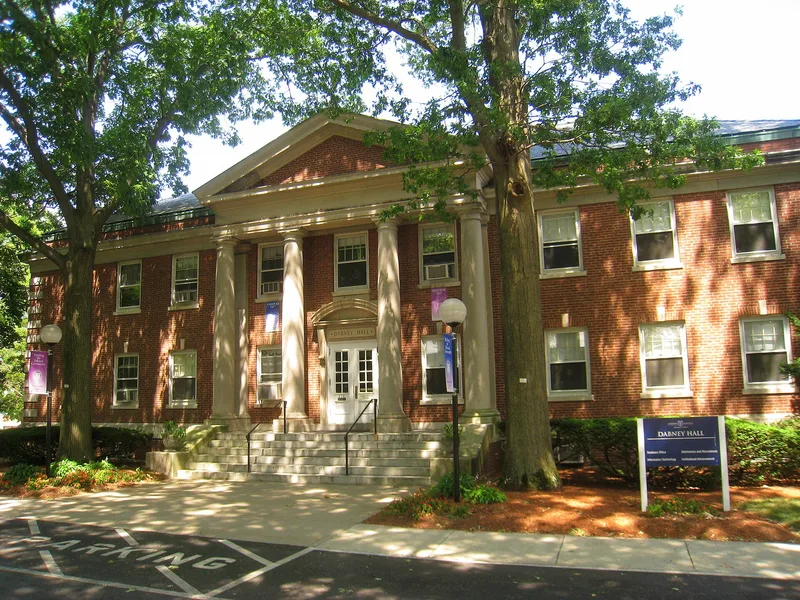
South of Newton Centre's commercial district, Institution Hill holds the campus of the Andover-Newton Theological School and a small residential neighborhood along Herrick Road. The seminary began in 1825 as the Newton Theological Institution, founded by the Massachusetts Baptist Education Society, and is considered the country's oldest Baptist seminary. In 1829 the society bought an 85-acre property including a mansion built in 1790. Farwell Hall (1829, with a third story and Mansard roof added in 1857) was the first permanent building, followed by Colby Hall (1866), a granite Mansard and Romanesque Revival building already listed individually, and Sturtevant Hall (1873). The nearby houses show Italianate, Mansard, Queen Anne, Stick and Colonial Revival design, built for Boston commuters, local entrepreneurs and people tied to the school. The school drew scholars such as Samuel Francis Smith, who wrote the words to "America" as a student. The district is recognized for its role in Newton's educational history and for its 19th-century architecture.
Significance in brief: The Newton Theological Institution, founded in 1825, was one of several important educational and cultural institutions in 19th-century Newton and was the first important outside educational institution to locate in the town. The district also contains outstanding examples of 19th-century domestic and institutional architecture, including Federal, Mansard, Romanesque Revival, Italianate, Queen Anne and Colonial Revival buildings.
Machine-generated summary. This summary was generated by a language model from the official nomination document and has not been reviewed line by line by an editor. It may contain errors. Check the source document before relying on any detail. Source: nomination document (PDF) · National Archives catalog entry. NRHP reference 86001749, listed September 4, 1986. Summary generated October 2026 (model claude-sonnet-5-5, prompt v1.0-2026-10-29, confidence medium).
Key facts
| Address | Roughly bounded by Braeland Ave., Ripley St. and Langley Rd., Bowdoin School Access Rd., and Cypress St., Newton |
|---|---|
| County | Middlesex County |
| Listed | September 4, 1986 |
| Reference number | 86001749 |
| Resource type | District |
| Period of significance | 1825-present |
| Architectural style | Federal, Mansard, Romanesque Revival, Italianate, Queen Anne, Stick, Colonial Revival |
| Criteria |
|
| Areas of significance | Education, Architecture |
| Level of significance | State, Local |
| Status (as stated in the nomination) | General condition is stated as excellent; present use is institutional and residential. The inventory lists 28 buildings, 14 of them non-contributing, plus one vacant lot. |
| Acreage | 44.7 |
| Coordinates | 42.32567, -71.18992 (NPS GIS) |
What listing means for this property
This is a historic district. Buildings within its boundary are either contributing (they add to the district's significance) or non-contributing. Owners of contributing income-producing buildings can claim the 20% federal rehabilitation tax credit; homeowners should look at state credits. National Register districts impose no design review by themselves; a local historic district ordinance, if one exists, does (the difference explained).
General information, not legal or tax advice. Rules change; confirm with your State Historic Preservation Office or a qualified adviser.
Sources and further reading
- National Park Service, National Register of Historic Places database (snapshot May 2026), reference 86001749.
- Nomination form (PDF, National Archives) — catalog entry
- Wikipedia article (used for cross-checking only; text not reproduced here)
- Wikidata Q7020392
- This listing as JSON
Last updated October 2026. Found an error? See the editorial policy for how to report it.