East Holliston Historic District

Why it's listed
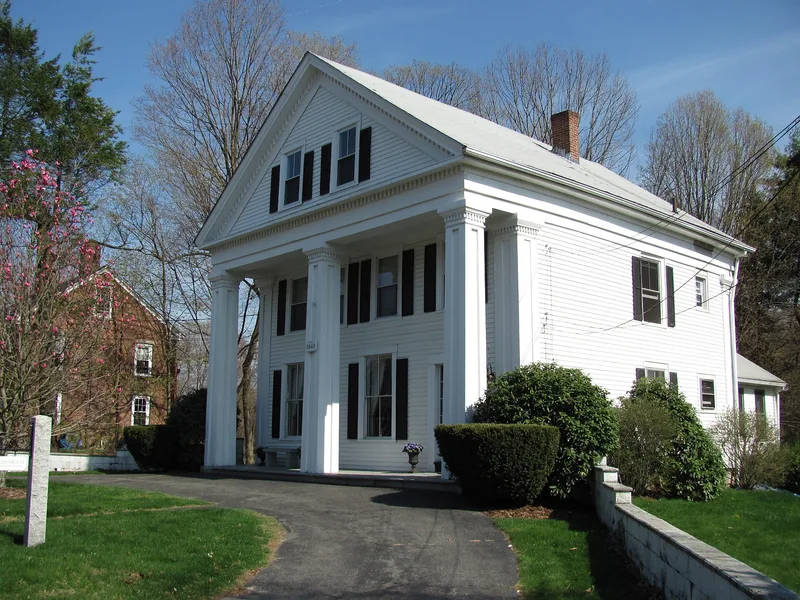
East Holliston is a linear neighborhood of mostly wood-frame houses strung along Washington Street in the eastern part of Holliston, Massachusetts, with a few side streets such as Curve Street. The oldest building is believed to date to about 1750, and most others were built in the 19th century. Jarr Brook powered early mills and factories that made lumber, grain products, carriages, horn combs, copper pumps and nails. The arrival of the railroad in 1847 and a thriving shoe trade fueled population growth, and most houses went up between 1820 and 1860 in Federal and Greek Revival styles. Cape Cod cottages, a rare brick house, former stores and two converted schoolhouses add variety. Of the early industries, only the 1837 Wilder Shop survives, now used as retail space. Alterations such as replacement windows and artificial siding have been modest, and the district keeps its historic character. A small early 19th-century burial ground, stone walls, barns and mature shade trees complete the setting.
Significance in brief: The district preserves a mill and shoemaking village whose houses, mostly built between 1820 and 1860, show Georgian, Federal and Greek Revival styles. Jarr Brook powered early industries such as mills, comb and pump making, and the railroad and shoe trade drove growth. The district retains integrity of location, design, setting, materials, workmanship, feeling and association.
Machine-generated summary. This summary was generated by a language model from the official nomination document and has not been reviewed line by line by an editor. It may contain errors. Check the source document before relying on any detail. Source: nomination document (PDF) · National Archives catalog entry. NRHP reference 02000636, listed June 14, 2002. Summary generated October 2026 (model claude-sonnet-5-5, prompt v1.0-2026-10-29, confidence medium).
Key facts
| Address | Washington, Baker, Curve, Woodland St., Quail Run, Holliston |
|---|---|
| County | Middlesex County |
| Listed | June 14, 2002 |
| Reference number | 02000636 |
| Resource type | District |
| Architectural style | Colonial Georgian, Federal, Greek Revival, Gothic, Italianate, Second Empire, Queen Anne, Shingle style, Bungalow |
| Areas of significance | Architecture, Community Planning and Development |
| Level of significance | Local |
| Status (as stated in the nomination) | Almost entirely residential today; some buildings serve as apartments, offices or retail space, and most are in a good state of preservation. |
| Acreage | 75 |
| Coordinates | 42.21410, -71.41953 (NPS GIS) |
What listing means for this property
This is a historic district. Buildings within its boundary are either contributing (they add to the district's significance) or non-contributing. Owners of contributing income-producing buildings can claim the 20% federal rehabilitation tax credit; homeowners should look at state credits. National Register districts impose no design review by themselves; a local historic district ordinance, if one exists, does (the difference explained).
General information, not legal or tax advice. Rules change; confirm with your State Historic Preservation Office or a qualified adviser.
Sources and further reading
- National Park Service, National Register of Historic Places database (snapshot May 2026), reference 02000636.
- Nomination form (PDF, National Archives) — catalog entry
- Wikipedia article (used for cross-checking only; text not reproduced here)
- Wikidata Q5328619
- This listing as JSON
Last updated October 2026. Found an error? See the editorial policy for how to report it.