Beck-Warren House
Also known as: Warren House

Why it's listed
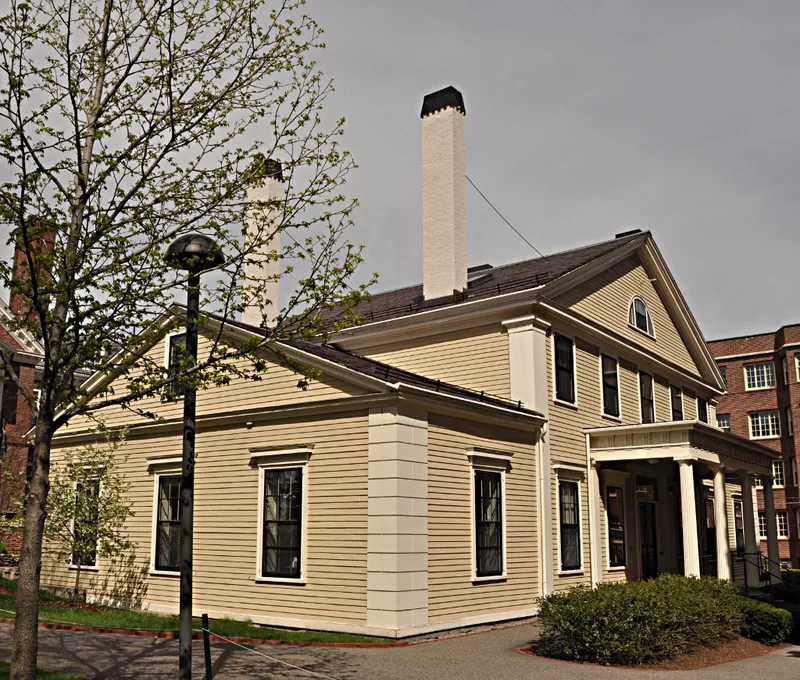
Built in 1833 at 1 Prescott Street in Cambridge, this Greek Revival house was made for Charles Beck, a German-born Latin professor at Harvard. It has a five-bay, center-entrance plan, flanking one-and-a-half story wings, clapboard walls, a slate roof and a Greek Doric porch that was unusually correct for 1830s Cambridge. Henry Clarke Warren, a Sanskrit and Pali scholar, bought it in 1891. Disabled by a spinal injury in childhood, he had the interior remodelled in Colonial Revival taste to suit his needs. The changes included oak-panelled rooms, skylights, a raised sleeping platform with a tambour door, a tiled bath and built-in aquariums. In 1897 a brick rear porch with blue-green Grueby tile, designed by H. Langford Warren, was added. Warren left the house to Harvard in 1899, and it has since served the university for library and academic use. Beck's role in bringing German scholarship to Harvard and Warren's translations of Buddhist texts underpin its listing, along with its architecture.
Significance in brief: It is nominated under Criteria B and C. It is associated with Charles Beck, a German-born Harvard classicist, and Henry Clarke Warren, a pioneering American scholar of Pali and Buddhism. It is an early local example of Greek Revival design with an unusual plan and a classically correct Doric portico. Its interior preserves features adapted for Warren's disability, and its 1897 rear porch has Grueby tile.
Machine-generated summary. This summary was generated by a language model from the official nomination document and has not been reviewed line by line by an editor. It may contain errors. Check the source document before relying on any detail. Source: nomination document (PDF) · National Archives catalog entry. NRHP reference 96000520, listed May 20, 1996. Summary generated October 2026 (model claude-sonnet-5-5, prompt v1.0-2026-10-29, confidence high).
Key facts
| Address | 1 Prescott St., Cambridge |
|---|---|
| County | Middlesex County |
| Listed | May 20, 1996 |
| Reference number | 96000520 |
| Resource type | Building |
| Period of significance | 1833 - 1946 |
| Architectural style | Mid-19th Century: Greek Revival; Late 19th and 20th Century Revivals: Colonial Revival |
| Criteria |
|
| Areas of significance | Philosophy, Education, Architecture |
| Level of significance | Local |
| Status (as stated in the nomination) | Owned by Harvard since 1899; used as a philological library and, since the early 20th century, as English department offices. Service areas have been converted to academic offices. |
| Acreage | 0.9 |
| Coordinates | 42.37252, -71.11446 (NPS GIS) |
What listing means for this property
National Register listing is honorary for a privately owned home: it does not by itself restrict what an owner may do with their own money, and it does not require public access. Restrictions come from local landmark or historic-district ordinances, which are separate (how they differ).
Owner-occupied houses are not eligible for the 20% federal rehabilitation tax credit, which applies to income-producing buildings, but many states offer credits for homeowners. Listing also opens the door to preservation easements and to buying a plaque. Start with what listing means for homeowners, renovating a listed house and selling one.
General information, not legal or tax advice. Rules change; confirm with your State Historic Preservation Office or a qualified adviser.
Sources and further reading
- National Park Service, National Register of Historic Places database (snapshot May 2026), reference 96000520.
- Nomination form (PDF, National Archives) — catalog entry
- Wikipedia article (used for cross-checking only; text not reproduced here)
- Wikidata Q4878591
- This listing as JSON
Last updated October 2026. Found an error? See the editorial policy for how to report it.