Lockville Historic District
Also known as: Strongs' Mill; Lyman Mill; Red Brook Mill Pond Area

Why it's listed
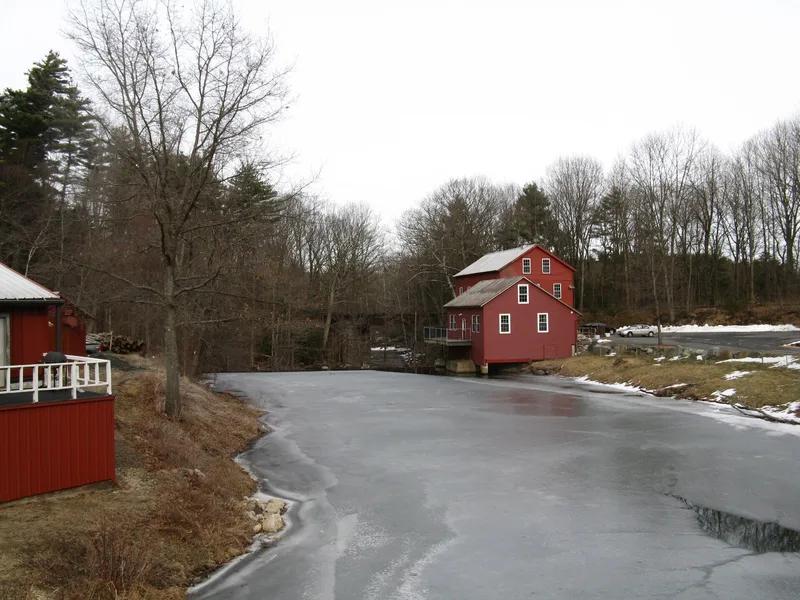
Lockville is a small rural district astride the Manhan River on College Highway, about a mile south of Southampton center. For nearly two centuries the spot has served industry and transport. A natural drop in the river created a mill privilege, and the area was later crossed by the Hampshire & Hampden canal in the 1830s and a railroad in the mid-1850s. The district includes the Ichabod Strong House of about 1768, the Federal-style Lockville Hotel of 1828, a canal storehouse of about 1832, the only surviving stone-lined canal lock remnant of that canal in Massachusetts, a railroad trestle, the Lyman Mill moved to its present site in 1877, a 1938 dam, and the Lyman Sheet Metal complex begun in the 1890s. Mill pond and surrounding hills remain largely free of modern intrusions. It was listed for local significance under criteria A, C and D, with a consideration for the moved mill building.
Significance in brief: The district is argued to be significant for its long role as a locus of small-scale industry and transportation, including a mill privilege, the 1830s canal and the 1850s railroad. It retains its rural setting and key historic buildings and structures. It also relates to local industries such as milling and the Lyman Sheet Metal Company.
Machine-generated summary. This summary was generated by a language model from the official nomination document and has not been reviewed line by line by an editor. It may contain errors. Check the source document before relying on any detail. Source: nomination document (PDF) · National Archives catalog entry. NRHP reference 00001657, listed January 24, 2001. Summary generated October 2026 (model claude-sonnet-5-5, prompt v1.0-2026-10-29, confidence medium).
Key facts
| Address | College Hwy., Southampton |
|---|---|
| County | Hampshire County |
| Listed | January 24, 2001 |
| Reference number | 00001657 |
| Resource type | District |
| Architect / builder | Stephen Wolcott (contractor, Lockville Hotel, 1828) |
| Architectural style | Colonial: Georgian; Early Republic: Federal; Other: Industrial |
| Criteria |
|
| Areas of significance | Industry, Transportation, Historic - Non-Aboriginal |
| Level of significance | Local |
| Status (as stated in the nomination) | Lyman Mill was converted in 1999 to an ice cream and sandwich shop; the Canal Storehouse is a residence; the Lockville Hotel is a duplex; the Lyman Sheet Metal Company continues in business. |
| Acreage | 240 |
| Coordinates | 42.21696, -72.72936 (NPS GIS) |
What listing means for this property
This is a historic district. Buildings within its boundary are either contributing (they add to the district's significance) or non-contributing. Owners of contributing income-producing buildings can claim the 20% federal rehabilitation tax credit; homeowners should look at state credits. National Register districts impose no design review by themselves; a local historic district ordinance, if one exists, does (the difference explained).
General information, not legal or tax advice. Rules change; confirm with your State Historic Preservation Office or a qualified adviser.
Sources and further reading
- National Park Service, National Register of Historic Places database (snapshot May 2026), reference 00001657.
- Nomination form (PDF, National Archives) — catalog entry
- Wikipedia article (used for cross-checking only; text not reproduced here)
- Wikidata Q6665870
- This listing as JSON
Last updated October 2026. Found an error? See the editorial policy for how to report it.