Twin Lights Historic District-Cape Ann Light Station
Also known as: Thatcher's Island Twin Lights; Cape Anne Light Station

Why it's listed
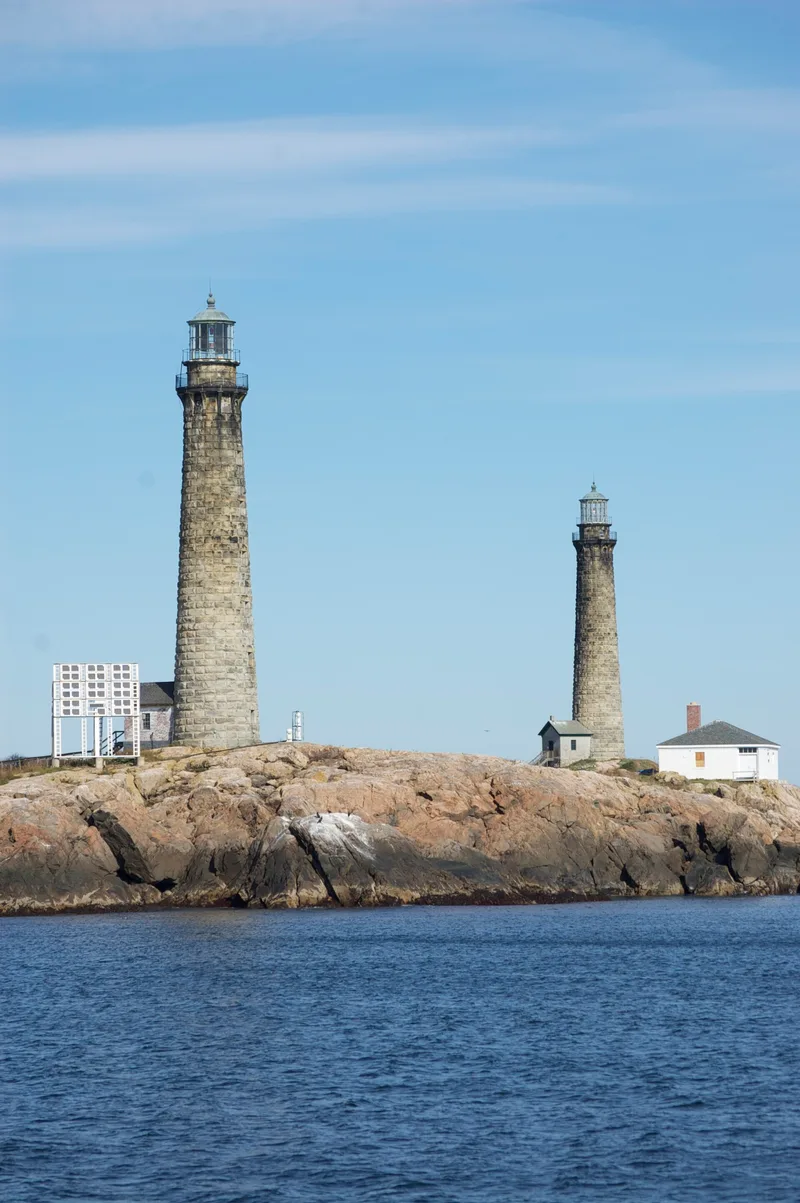
Thacher's Island, about a mile off Rockport on Cape Ann, carries two circular granite lighthouse towers, each 124 feet tall, built in 1860-61. The battered stone walls have slit windows lighting the interior stairs, two balconies at the top, and a one-story brick entrance building at the base of each tower. A few late 19th century wooden houses stand near the southeast light. The island is named for Anthony Thacher, who survived a 1635 shipwreck that killed his children and others. Massachusetts authorized twin lights in 1771, and the original 45-foot towers were first lit that December. The federal government took them over in 1789, and Congress funded their rebuilding in 1859. The nomination states they are the last twin lights in the United States. The north tower went out of use in 1932, while the southeast tower remains active with an electric light visible for 19 miles. Both towers appear on Rockport's town seal.
Significance in brief: The nomination calls these the last twin lights in existence in the United States. Twin lights were an early way to tell one lighthouse from another, and the rest were dismantled or destroyed once revolving lenses made distinct patterns possible. The island also has a long history, with the first twin lights lit in 1771 and a shipwreck in 1635 that gave the island its name.
Machine-generated summary. This summary was generated by a language model from the official nomination document and has not been reviewed line by line by an editor. It may contain errors. Check the source document before relying on any detail. Source: nomination document (PDF) · National Archives catalog entry. NRHP reference 71000355, listed October 7, 1971. Summary generated October 2026 (model claude-sonnet-5-5, prompt v1.0-2026-10-29, confidence medium).
Key facts
| Address | 1 mi. E of Rockport on Thatcher's Island, Rockport |
|---|---|
| County | Essex County |
| Listed | October 7, 1971 |
| Reference number | 71000355 |
| Resource type | District |
| Areas of significance | Engineering, Transportation |
| Level of significance | National, Local |
| National Historic Landmark | Yes, designated January 3, 2001 |
| Status (as stated in the nomination) | The southeast light is in operation and in excellent condition, maintained by the Coast Guard. The north light, discontinued in 1932, needs weather protection, and the north light and 22 acres were slated for disposal. |
| Acreage | 50 |
| Coordinates | 42.63738, -70.57642 (NPS GIS) |
What listing means for this property
This is a historic district. Buildings within its boundary are either contributing (they add to the district's significance) or non-contributing. Owners of contributing income-producing buildings can claim the 20% federal rehabilitation tax credit; homeowners should look at state credits. National Register districts impose no design review by themselves; a local historic district ordinance, if one exists, does (the difference explained).
General information, not legal or tax advice. Rules change; confirm with your State Historic Preservation Office or a qualified adviser.
Sources and further reading
- National Park Service, National Register of Historic Places database (snapshot May 2026), reference 71000355.
- Nomination form (PDF, National Archives) — catalog entry
- Wikipedia article (used for cross-checking only; text not reproduced here)
- Wikidata Q5034568
- This listing as JSON
Last updated October 2026. Found an error? See the editorial policy for how to report it.