Gerry, Elbridge, House

Why it's listed
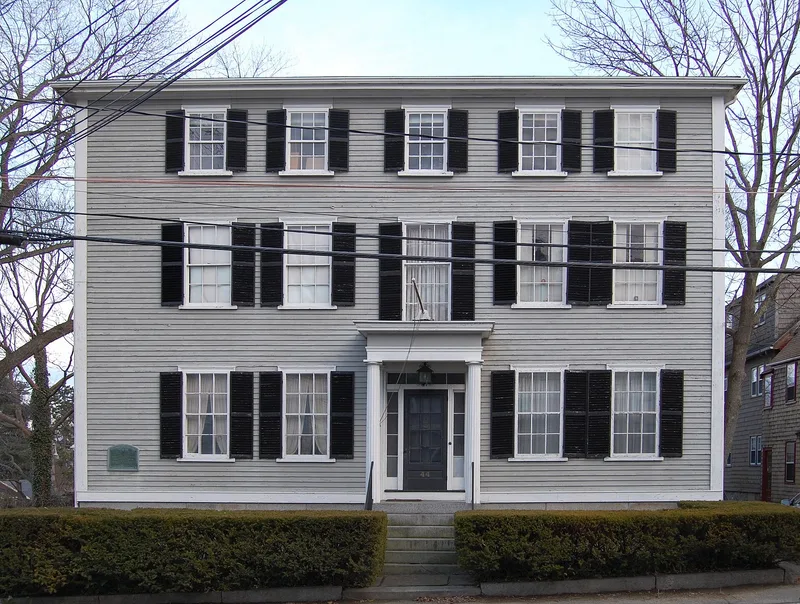
Elbridge Gerry's birthplace at 44 Washington Street in Marblehead began as a two-story, L-shaped Georgian frame house built about 1730 by Thomas Gerry. The family kept it until 1820, when a new owner raised the building and inserted a new first story beneath it, creating the three-story form seen today. Clapboard walls, a hip roof, a center hall plan and a porch with two fluted columns characterize the house. The second-floor bedrooms retain their original 18th-century panelling, while the first floor is entirely 19th-century. Elbridge Gerry was born here in 1744 and lived in the house until 1787. He signed the Declaration of Independence and the Articles of Confederation, served as Governor of Massachusetts, and became Vice President under James Madison. His second administration is remembered for the 1812 redistricting bill that gave the word gerrymander to the language. The house sits within the Old Town Historic District and remains a well-kept private residence.
Significance in brief: The house was the birthplace and home, from 1744 to 1787, of Elbridge Gerry, a Signer of the Declaration of Independence, Governor of Massachusetts and Vice President of the United States. His second term as governor produced the Gerrymander Bill of 1812. The house lies within the Old Town Historic District and was considered for National Historic Landmark designation.
Machine-generated summary. This summary was generated by a language model from the official nomination document and has not been reviewed line by line by an editor. It may contain errors. Check the source document before relying on any detail. Source: nomination document (PDF) · National Archives catalog entry. NRHP reference 73000304, listed July 2, 1973. Summary generated October 2026 (model claude-sonnet-5-5, prompt v1.0-2026-10-29, confidence high).
Key facts
| Address | 44 Washington St., Marblehead |
|---|---|
| County | Essex County |
| Listed | July 2, 1973 |
| Reference number | 73000304 |
| Resource type | Building |
| Period of significance | 1744-1787 |
| Architect / builder | Thomas Gerry (built about 1730) |
| Architectural style | Georgian frame structure, remodeled about 1820 |
| Areas of significance | Politics/Government |
| Level of significance | National |
| Status (as stated in the nomination) | Private residence in good condition; the house and grounds are well maintained and the structure appears little altered since the 1820 remodeling. |
| Acreage | 0.5 |
| Coordinates | 42.50675, -71.86425 (NPS GIS) |
What listing means for this property
National Register listing is honorary for a privately owned home: it does not by itself restrict what an owner may do with their own money, and it does not require public access. Restrictions come from local landmark or historic-district ordinances, which are separate (how they differ).
Owner-occupied houses are not eligible for the 20% federal rehabilitation tax credit, which applies to income-producing buildings, but many states offer credits for homeowners. Listing also opens the door to preservation easements and to buying a plaque. Start with what listing means for homeowners, renovating a listed house and selling one.
General information, not legal or tax advice. Rules change; confirm with your State Historic Preservation Office or a qualified adviser.
Sources and further reading
- National Park Service, National Register of Historic Places database (snapshot May 2026), reference 73000304.
- Nomination form (PDF, National Archives) — catalog entry
- Wikipedia article (used for cross-checking only; text not reproduced here)
- Wikidata Q5353816
- This listing as JSON
Last updated October 2026. Found an error? See the editorial policy for how to report it.