Old Mill

Why it's listed
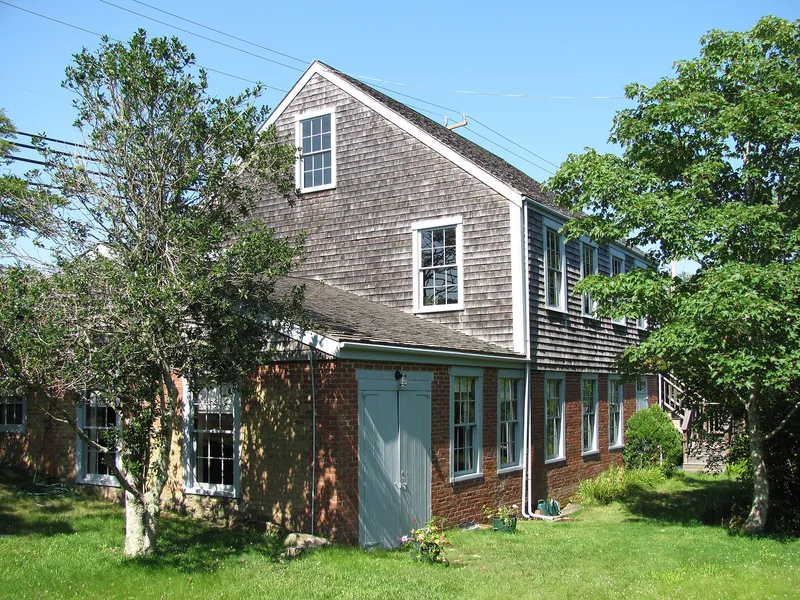
Set into a south-facing slope beside the Edgartown-West Tisbury Road, this small mill was built around 1848 by retired whaling captain Thomas Bradley on a site used for milling since about 1650. The 2½-story frame building rests on brick and rubblestone foundations, with a 1½-story ell, simple wood trim and 6/6 windows. From 1809 the mill wove satinet, a dense woolen cloth favored for seamen's clothing, and its decline in the 1870s paralleled the fall of whaling. Machinery was sold for junk in 1879. Later uses included a tea room, sandwich shop, art gallery and auction house before the Martha's Vineyard Garden Club rented it in 1937 and bought it in 1942. It is considered the oldest surviving industrial building in the community and a well-preserved example of plain 19th-century industrial design. The surrounding land may also hold prehistoric and early industrial remains, since several prehistoric sites lie nearby.
Significance in brief: The nomination argues it is the oldest surviving industrial building in the community and a well-preserved example of its type. Its site is tied to West Tisbury's development from the 17th century onward, including woolen cloth production linked to the island's whaling economy and ownership by Captain Thomas Bradley. The surrounding land may also yield prehistoric and historic archaeological information.
Machine-generated summary. This summary was generated by a language model from the official nomination document and has not been reviewed line by line by an editor. It may contain errors. Check the source document before relying on any detail. Source: nomination document (PDF) · National Archives catalog entry. NRHP reference 84002303, listed March 29, 1984. Summary generated October 2026 (model claude-sonnet-5-5, prompt v1.0-2026-10-29, confidence high).
Key facts
| Address | Edgartown-West Tisbury Rd., West Tisbury |
|---|---|
| County | Dukes County |
| Listed | March 29, 1984 |
| Reference number | 84002303 |
| Resource type | Building |
| Architect / builder | Unknown |
| Architectural style | 19th century vernacular industrial design |
| Criteria |
|
| Areas of significance | Industry, Commerce, Architecture |
| Level of significance | Local |
| Status (as stated in the nomination) | Listed in excellent condition and occupied; used for meetings by its owner, a garden club, which has held it since 1942. |
| Acreage | 26 |
| Coordinates | 41.38206, -70.67170 (NPS GIS) |
What listing means for this property
For an income-producing building, listing (individually or as a contributing building in a district) is the gateway to the 20% federal rehabilitation tax credit on qualified rehabilitation costs, often stackable with state credits. Work claiming the credit must follow the Secretary of the Interior's Standards and be approved in advance.
Listing does not restrict a private owner acting without federal money or permits; where federal funding or licensing is involved, Section 106 review applies.
General information, not legal or tax advice. Rules change; confirm with your State Historic Preservation Office or a qualified adviser.
Sources and further reading
- National Park Service, National Register of Historic Places database (snapshot May 2026), reference 84002303.
- Nomination form (PDF, National Archives) — catalog entry
- Wikipedia article (used for cross-checking only; text not reproduced here)
- Wikidata Q7084520
- This listing as JSON
Last updated October 2026. Found an error? See the editorial policy for how to report it.