Tyringham Shaker Settlement Historic District

Why it's listed
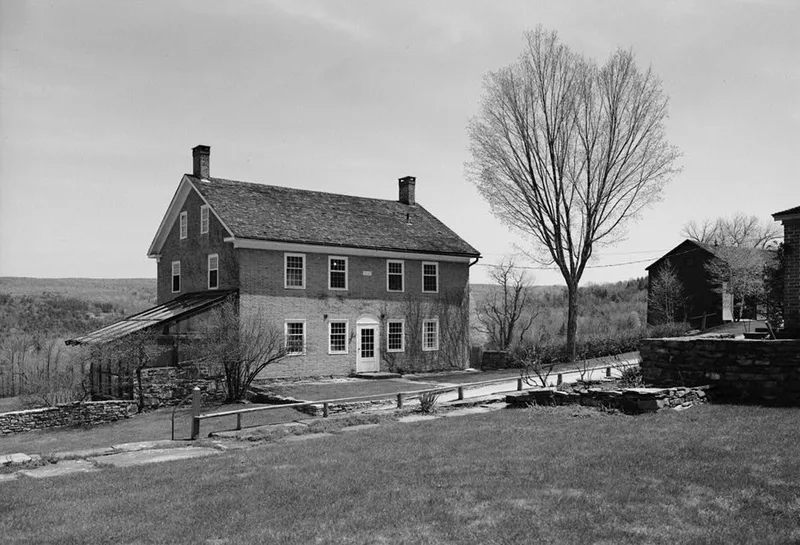
Along Jerusalem Road on the slope of Sky Hill in Tyringham, a string of brick and wooden buildings, stone dams and foundations marks the site of Massachusetts' fourth Shaker community. The Shakers lived here from 1792 until 1874, organized into Church, North and South families. The Church Family core includes the ca. 1800 Dormitory, the Elders Dwelling of 1823, the Cobbler Shop, a Workshop and the Great Barn, mostly vernacular buildings showing the shift from Federal to Greek Revival styles. Outlying clusters were built around water power: dry-laid stone dams, mill foundations at Shaker Pond, and the remains of the multipurpose Red Shop. The community's meetinghouse and seed house were moved elsewhere in the 1900s. The district was listed for its architecture, social history, religion, planning and archaeology. Its landscape and ruins show how a farming and manufacturing society worked until its dwindling membership closed the settlement, the first major Shaker society to do so.
Significance in brief: The nomination presents the district as an exceptionally well-preserved reminder of a Shaker community that lived on the hillside until 1874, when it became the first major Shaker society to close. It is significant for its architecture, social history, religion, community planning and development, and historic archaeology. Its dormitory, workshops, barns, dams and mill foundations show how the Shakers organized living, work and water power.
Machine-generated summary. This summary was generated by a language model from the official nomination document and has not been reviewed line by line by an editor. It may contain errors. Check the source document before relying on any detail. Source: nomination document (PDF) · National Archives catalog entry. NRHP reference 87001785, listed October 15, 1987. Summary generated October 2026 (model claude-sonnet-5-5, prompt v1.0-2026-10-29, confidence medium).
Key facts
| Address | Jerusalem Rd., Tyringham |
|---|---|
| County | Berkshire County |
| Listed | October 15, 1987 |
| Reference number | 87001785 |
| Resource type | District |
| Period of significance | ca. 1770-1874 |
| Architectural style | Early Republic - Federal; Mid 19th Century - Greek Revival; Late Victorian - Italianate |
| Criteria |
|
| Areas of significance | Community Planning and Development, Historic - Non-Aboriginal, Architecture, Religion, Social History |
| Level of significance | State, Local |
| Status (as stated in the nomination) | Many original buildings are gone and survive only as foundations or ruins. Several surviving structures are in residential or other adapted use, such as the Carriage Barn used as a garage and the Great Barn's cattle sheds, which now house an apartment. |
| Acreage | 110.5 |
| Coordinates | 42.24678, -73.22282 (NPS GIS) |
What listing means for this property
This is a historic district. Buildings within its boundary are either contributing (they add to the district's significance) or non-contributing. Owners of contributing income-producing buildings can claim the 20% federal rehabilitation tax credit; homeowners should look at state credits. National Register districts impose no design review by themselves; a local historic district ordinance, if one exists, does (the difference explained).
General information, not legal or tax advice. Rules change; confirm with your State Historic Preservation Office or a qualified adviser.
Sources and further reading
- National Park Service, National Register of Historic Places database (snapshot May 2026), reference 87001785.
- Nomination form (PDF, National Archives) — catalog entry
- Wikipedia article (used for cross-checking only; text not reproduced here)
- Wikidata Q7861525
- This listing as JSON
Last updated October 2026. Found an error? See the editorial policy for how to report it.