Sheffield Plain Historic District

Why it's listed
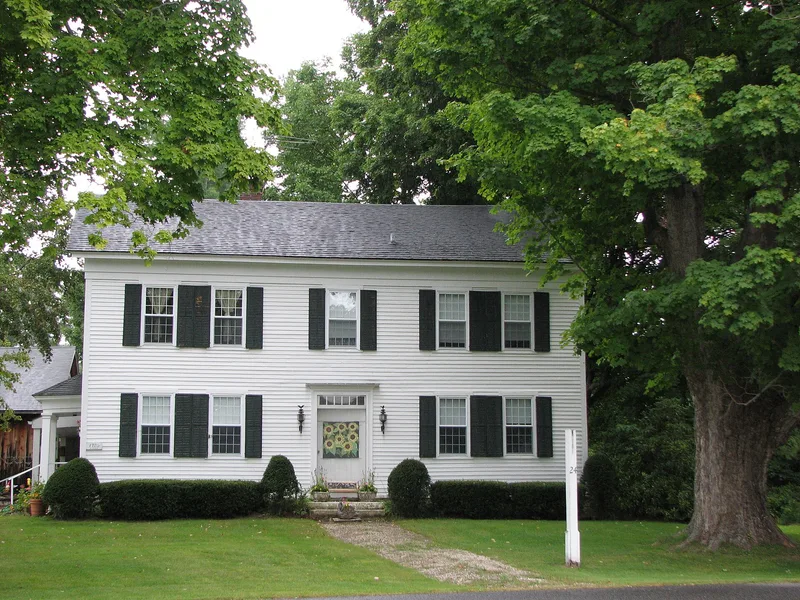
Sheffield Plain is a linear village strip of about twenty-seven acres along U.S. Route 7 in north-central Sheffield, Massachusetts. It was the town's first settlement core and first town center, and the pattern of closely set houses reflects the original land allotments to early proprietors. The district holds 23 contributing buildings, four sites and four objects, including the Noble-Barnum House, which incorporates a house of about 1726 believed to be the oldest surviving in Berkshire County. Capes, Georgian farmhouses, Greek Revival houses and cottages, and one bungalow show vernacular interpretations of popular styles. Two early cemeteries and the old militia training ground, the probable site of the first meetinghouse, are also included. The town's institutional focus moved south to Sheffield Center in 1760, leaving the Plain mainly residential, with most building between 1810 and 1858. Small shops once stood along the turnpike, and the former commercial buildings survive as homes. Facades remain largely unchanged, and modern intrusions are modest.
Significance in brief: The district preserves the town's earliest settlement core and first town center, with land patterns that reflect the original allotment to proprietors. Its houses show vernacular Georgian, Federal and Greek Revival design and the gradual growth of a village over about two hundred years. It is judged significant at the local level under Criteria A and C.
Machine-generated summary. This summary was generated by a language model from the official nomination document and has not been reviewed line by line by an editor. It may contain errors. Check the source document before relying on any detail. Source: nomination document (PDF) · National Archives catalog entry. NRHP reference 88000881, listed June 23, 1988. Summary generated October 2026 (model claude-sonnet-5-5, prompt v1.0-2026-10-29, confidence high).
Key facts
| Address | Roughly 1/2 mi. of US 7, S from Cook Rd., Sheffield |
|---|---|
| County | Berkshire County |
| Listed | June 23, 1988 |
| Reference number | 88000881 |
| Resource type | District |
| Period of significance | ca. 1726-1920 |
| Architectural style | Mid-19th Century: Greek Revival; Early Republic: Federal; Colonial: Georgian; Early 20th c.: Bungalow |
| Criteria |
|
| Areas of significance | Community Planning and Development, Exploration/Settlement, Politics/Government, Architecture |
| Level of significance | Local |
| Status (as stated in the nomination) | All contributing buildings are now residences; two serve as apartment or boarding houses and four are also used as antique shops. |
| Acreage | 27 |
| Coordinates | 42.12037, -73.35541 (NPS GIS) |
What listing means for this property
This is a historic district. Buildings within its boundary are either contributing (they add to the district's significance) or non-contributing. Owners of contributing income-producing buildings can claim the 20% federal rehabilitation tax credit; homeowners should look at state credits. National Register districts impose no design review by themselves; a local historic district ordinance, if one exists, does (the difference explained).
General information, not legal or tax advice. Rules change; confirm with your State Historic Preservation Office or a qualified adviser.
Sources and further reading
- National Park Service, National Register of Historic Places database (snapshot May 2026), reference 88000881.
- Nomination form (PDF, National Archives) — catalog entry
- Wikipedia article (used for cross-checking only; text not reproduced here)
- Wikidata Q7492732
- This listing as JSON
Last updated October 2026. Found an error? See the editorial policy for how to report it.