Old Morrison Mill

Why it's listed
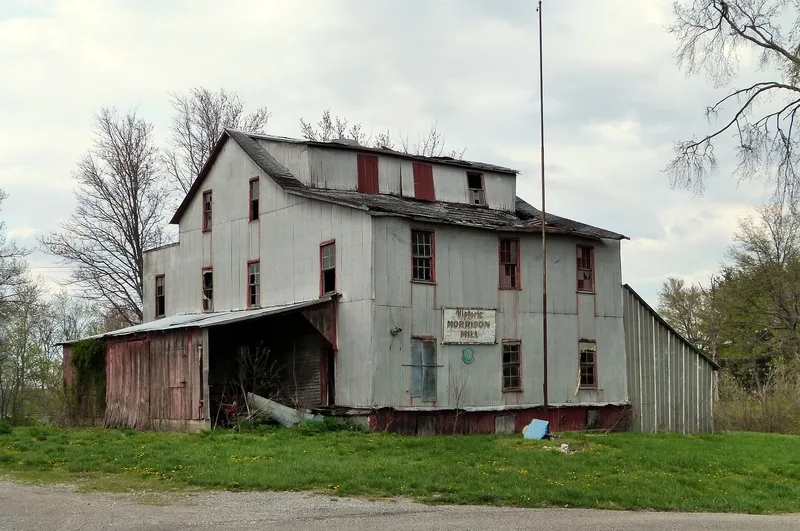
Old Morrison Mill is a large, square, four-story wood-frame grain mill in Burnt Prairie, Illinois, a town originally called Liberty. The frame was first built in Enfield in 1859 with handhewn braced timbers, then dismantled and re-erected at its present site by Holmes and Young. Inside, wooden elevators and pipes carry wheat and corn between floors, and cleaners, roller machines, sifters and buhrstones remain. Power came first from horses, then wood and coal steam, a diesel engine and finally electricity. The mill descends from a horse-drawn operation begun by Peter Morrison in 1820. The brothers R.S. and Cal Morrison bought it in 1897, and the family name became synonymous with cornmeal locally. Operations continued until 1963. The mill is significant as a well-preserved small-scale grain processing plant of the kind that allowed small towns to serve surrounding farmland. The building now stands idle.
Significance in brief: The nomination argues the mill is a well-preserved example of the small-scale grain processing plants that let late nineteenth and early twentieth century small towns serve as service centers for nearby farms. It descends from a horse-drawn mill begun by Peter Morrison in 1820, and the Morrison family name became synonymous with cornmeal locally. Much of its original milling machinery remains.
Machine-generated summary. This summary was generated by a language model from the official nomination document and has not been reviewed line by line by an editor. It may contain errors. Check the source document before relying on any detail. Source: nomination document (PDF) · National Archives catalog entry. NRHP reference 84001169, listed July 11, 1984. Summary generated October 2026 (model claude-sonnet-5-5, prompt v1.0-2026-10-29, confidence medium).
Key facts
| Address | Off Liberty Rd., Burnt Prairie |
|---|---|
| County | White County |
| Listed | July 11, 1984 |
| Reference number | 84001169 |
| Resource type | Building |
| Period of significance | 1800-1899, 1900- (specific date 1897) |
| Criteria |
|
| Areas of significance | Industry |
| Level of significance | State |
| Status (as stated in the nomination) | Described as unoccupied; the mill stands idle, though much of its machinery is still in usable condition. Condition is marked fair, and the building is marked moved. |
| Acreage | 0.9 |
| Coordinates | 38.24990, -88.25829 (NPS GIS) |
What listing means for this property
For an income-producing building, listing (individually or as a contributing building in a district) is the gateway to the 20% federal rehabilitation tax credit on qualified rehabilitation costs, often stackable with state credits. Work claiming the credit must follow the Secretary of the Interior's Standards and be approved in advance.
Listing does not restrict a private owner acting without federal money or permits; where federal funding or licensing is involved, Section 106 review applies.
Noted as vacant in the nomination. Nomination documents can be decades old; current status may differ. If you are considering buying an empty listed property, read the due-diligence checklist.
General information, not legal or tax advice. Rules change; confirm with your State Historic Preservation Office or a qualified adviser.
Sources and further reading
- National Park Service, National Register of Historic Places database (snapshot May 2026), reference 84001169.
- Nomination form (PDF, National Archives) — catalog entry
- Wikipedia article (used for cross-checking only; text not reproduced here)
- Wikidata Q15263832
- This listing as JSON
Last updated October 2026. Found an error? See the editorial policy for how to report it.