Tallman, Horace M., House

Why it's listed
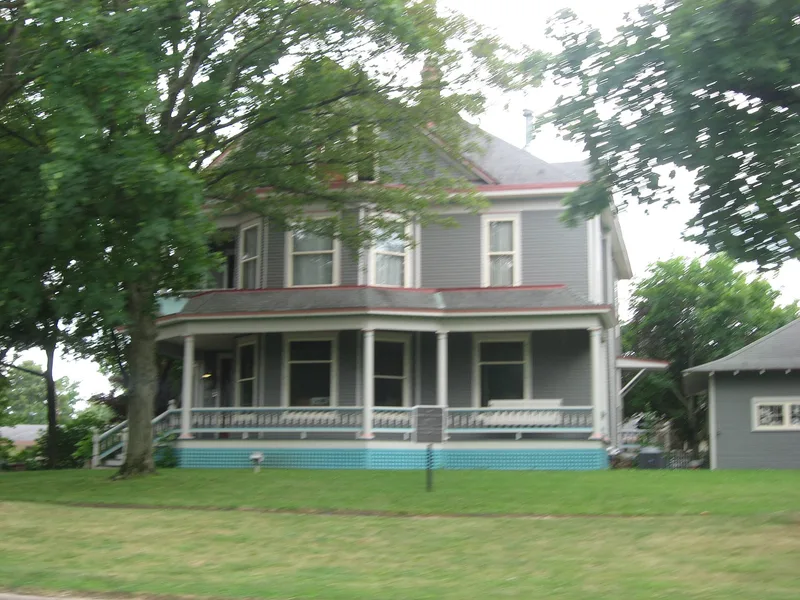
Built in 1905 by Horace M. Tallman at the corner of Main and Douglas Streets in Shelbyville, Illinois, this eight-room, two-story frame house shows Queen Anne features: an asymmetrical composition, a large bay, a columned wraparound porch, and a projecting pavilion. A Palladian window with a fanlight marks the front attic gable. Inside, dark stained fir woodwork and octagonal rooms with pocket doors remain. A ca. 1920 garage and a ca. 1915 pergola share the lot. The house matters because of its owner. Tallman moved the Ann Arbor Machine Company to Shelbyville in 1922 and, in 1928-29, conceived mounting a windrow pickup on a stationary baler. Tested in 1930, the pickup hay baler largely replaced the hay fork, loose hay loader, and stationary baler, and reached farms in many countries by the mid-1930s. This is the only surviving Shelbyville building closely tied to Tallman and that invention. Rehabilitation has left the house much as it was in 1905.
Significance in brief: The house is the only remaining building in Shelbyville closely associated with Horace Tallman and his invention of the first successful pickup hay baler. Tallman conceived the idea in 1928-29 after moving the Ann Arbor Machine Company to Shelbyville in 1922. The invention automated back-breaking haying work and spread rapidly around the world. The nomination argues significance in agriculture and engineering under Criterion A.
Machine-generated summary. This summary was generated by a language model from the official nomination document and has not been reviewed line by line by an editor. It may contain errors. Check the source document before relying on any detail. Source: nomination document (PDF) · National Archives catalog entry. NRHP reference 88000470, listed May 6, 1988. Summary generated October 2026 (model claude-sonnet-5-5, prompt v1.0-2026-10-29, confidence high).
Key facts
| Address | 816 W. Main, Shelbyville |
|---|---|
| County | Shelby County |
| Listed | May 6, 1988 |
| Reference number | 88000470 |
| Resource type | Building |
| Period of significance | 1929-1937 |
| Architect / builder | Horace M. Tallman (builder); architect unknown |
| Architectural style | Late Victorian: Queen Anne |
| Criteria |
|
| Areas of significance | Agriculture, Engineering |
| Level of significance | National |
| Status (as stated in the nomination) | Being entirely rehabilitated at the time of nomination for bed and breakfast and motel registration use; described as in excellent condition after rehabilitation. |
| Acreage | 0.2 |
| Coordinates | 39.40627, -88.80298 (NPS GIS) |
What listing means for this property
National Register listing is honorary for a privately owned home: it does not by itself restrict what an owner may do with their own money, and it does not require public access. Restrictions come from local landmark or historic-district ordinances, which are separate (how they differ).
Owner-occupied houses are not eligible for the 20% federal rehabilitation tax credit, which applies to income-producing buildings, but many states offer credits for homeowners. Listing also opens the door to preservation easements and to buying a plaque. Start with what listing means for homeowners, renovating a listed house and selling one.
General information, not legal or tax advice. Rules change; confirm with your State Historic Preservation Office or a qualified adviser.
Sources and further reading
- National Park Service, National Register of Historic Places database (snapshot May 2026), reference 88000470.
- Nomination form (PDF, National Archives) — catalog entry
- Wikipedia article (used for cross-checking only; text not reproduced here)
- Wikidata Q16901126
- This listing as JSON
Last updated October 2026. Found an error? See the editorial policy for how to report it.