Phoenix Opera House Block

Why it's listed
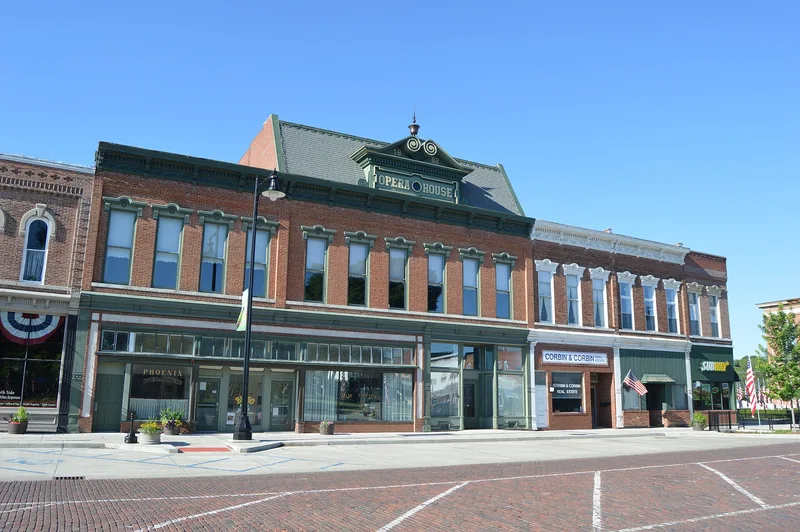
Six storefronts along the south side of the Rushville square, topped by a second-floor opera house, make up this commercial block built in 1882 after a January fire destroyed the earlier buildings. Two businessmen joined their upper floors to create a 40 by 80 foot hall, and a high Mansard roof marks the opera house section. The auditorium seated about 500 and was advertised as having the area's first fly gallery. Until 1910 it hosted touring productions, graduations, society balls, lectures and the town's first motion pictures. It was then shuttered until 1924, when the Masonic Lodge converted it into a lodge hall, replacing the stage with a balcony. The Masons left in 1956. Storefronts have been altered to varying degrees, though the second-floor facade is largely intact. The block matters as a rare surviving example of the combined opera house and commercial block, and as a marker of Rushville's emergence as a center of commerce and culture.
Significance in brief: The block marked a milestone in Rushville's growth, showing the town to be a center of commerce and culture rather than a rough frontier settlement. It reflects the regional practice of using street-level commercial rents to support an upstairs community hall. It is described as one of the few well-preserved examples of a combined opera house and commercial block, and it hosted the town's social and cultural life from 1882 to 1910.
Machine-generated summary. This summary was generated by a language model from the official nomination document and has not been reviewed line by line by an editor. It may contain errors. Check the source document before relying on any detail. Source: nomination document (PDF) · National Archives catalog entry. NRHP reference 85001010, listed May 9, 1985. Summary generated October 2026 (model claude-sonnet-5-5, prompt v1.0-2026-10-29, confidence high).
Key facts
| Address | 112-122 W. Lafayette St., Rushville |
|---|---|
| County | Schuyler County |
| Listed | May 9, 1985 |
| Reference number | 85001010 |
| Resource type | Building |
| Period of significance | 1800-1899 |
| Architect / builder | Thos. Wilson / Chas H. & Lewis C. Wells |
| Areas of significance | Entertainment/Recreation, Architecture |
| Level of significance | Local |
| Status (as stated in the nomination) | Marked occupied, in fair condition and altered. The Opera House space was leased by the Masons from 1924 to 1956. The sponsors aim to restore the facade and revive the hall as a performing arts center. |
| Acreage | 0.9 |
| Coordinates | 40.12037, -90.56280 (NPS GIS) |
What listing means for this property
National Register listing is honorary for a privately owned home: it does not by itself restrict what an owner may do with their own money, and it does not require public access. Restrictions come from local landmark or historic-district ordinances, which are separate (how they differ).
Owner-occupied houses are not eligible for the 20% federal rehabilitation tax credit, which applies to income-producing buildings, but many states offer credits for homeowners. Listing also opens the door to preservation easements and to buying a plaque. Start with what listing means for homeowners, renovating a listed house and selling one.
General information, not legal or tax advice. Rules change; confirm with your State Historic Preservation Office or a qualified adviser.
Sources and further reading
- National Park Service, National Register of Historic Places database (snapshot May 2026), reference 85001010.
- Nomination form (PDF, National Archives) — catalog entry
- Wikipedia article (used for cross-checking only; text not reproduced here)
- Wikidata Q14688020
- This listing as JSON
Last updated October 2026. Found an error? See the editorial policy for how to report it.