Black's Store
Also known as: Curiosity Shop

Why it's listed
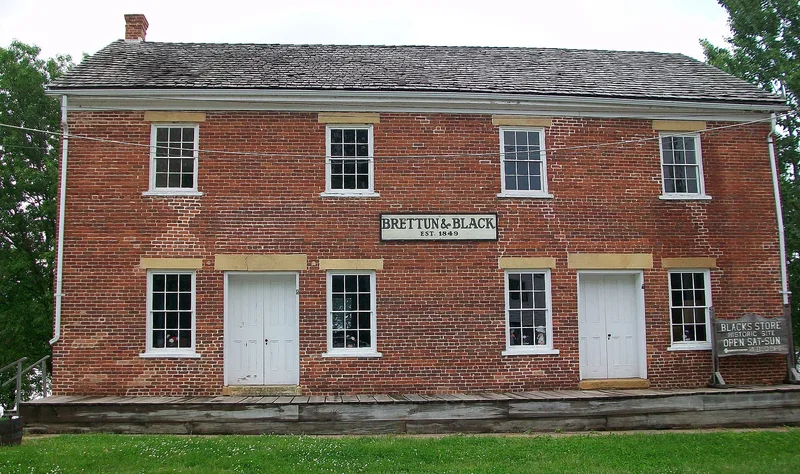
Built in 1846 beside the Mississippi River in Hampton, Illinois, Black's Store was a two-story brick building put up by partners Francis Black and Saranus Brettun. Its front faced the Galena Stage Road and the town's commercial district, while the back opened toward the river, where a wharf let steamboats dock. Local brick, timber and stone were used in construction. The partners were merchants who also ran a pork packing business. Barrels of pork and grain were held in the basement, goods were stocked upstairs, and farmers from a wide area came to trade. Over time the building also served as a post office, a stage stop and, in the 1930s, a private museum of curiosities. Store records from 1846 to well past 1900 are preserved at the Putnam Museum in Davenport, Iowa. Few surviving buildings are so closely tied to the commercial history of the Upper Mississippi. The structure is deteriorating, with cracked masonry and foliage covering much of it.
Significance in brief: The store reflects the era when the Mississippi River was the main avenue of western commerce. Black and Brettun operated as merchants and pork packers, trading retail goods with farmers for pork and grain shipped by steamboat. Store records from 1846 to well past 1900 survive at the Putnam Museum in Davenport, Iowa, documenting the shift from river commerce to a simple general store.
Machine-generated summary. This summary was generated by a language model from the official nomination document and has not been reviewed line by line by an editor. It may contain errors. Check the source document before relying on any detail. Source: nomination document (PDF) · National Archives catalog entry. NRHP reference 76000727, listed May 28, 1976. Summary generated October 2026 (model claude-sonnet-5-5, prompt v1.0-2026-10-29, confidence high).
Key facts
| Address | 1st Ave., Hampton |
|---|---|
| County | Rock Island County |
| Listed | May 28, 1976 |
| Reference number | 76000727 |
| Resource type | Building |
| Period of significance | 1800-1899 |
| Architect / builder | Unknown |
| Architectural style | Vernacular (a summary sheet lists no formal style) |
| Areas of significance | Commerce, Transportation |
| Level of significance | State |
| Status (as stated in the nomination) | Described as deteriorating, with settling, cracked brick and mortar, and repairs to the northwest corner; a reviewer's note calls it empty but minimally maintained. |
| Acreage | 0.9 |
| Coordinates | 41.55714, -90.41437 (NPS GIS) |
What listing means for this property
For an income-producing building, listing (individually or as a contributing building in a district) is the gateway to the 20% federal rehabilitation tax credit on qualified rehabilitation costs, often stackable with state credits. Work claiming the credit must follow the Secretary of the Interior's Standards and be approved in advance.
Listing does not restrict a private owner acting without federal money or permits; where federal funding or licensing is involved, Section 106 review applies.
Noted as vacant in the nomination. Nomination documents can be decades old; current status may differ. If you are considering buying an empty listed property, read the due-diligence checklist.
General information, not legal or tax advice. Rules change; confirm with your State Historic Preservation Office or a qualified adviser.
Sources and further reading
- National Park Service, National Register of Historic Places database (snapshot May 2026), reference 76000727.
- Nomination form (PDF, National Archives) — catalog entry
- Wikipedia article (used for cross-checking only; text not reproduced here)
- Wikidata Q4920042
- This listing as JSON
Last updated October 2026. Found an error? See the editorial policy for how to report it.