Scott, Lyman, House
Also known as: Grote House

Why it's listed
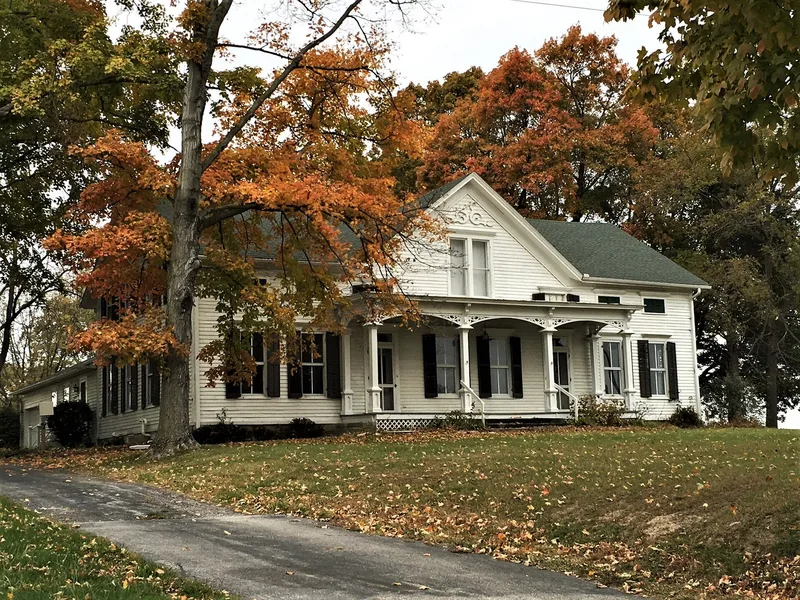
Built around 1844 as a summer home for Lyman Scott, this frame house on U.S. Route 54 in Summer Hill, Pike County, Illinois, is the oldest known residence still standing in the village. Scott laid out the town of Summer Hill beside it in 1845. He had earlier founded Rockport and worked as a merchant, inventor, innkeeper and flatboat operator, later serving in the Kansas legislature and attending a World's Peace Congress in Germany in 1850. The house measures roughly 62 by 32 feet and has clapboard siding over post-and-beam framing, original bark-covered log floor joists, plaster over hand-split lath, and a porch with a carved balustrade. A dormer added in the 1870s is the main exterior change. Scott's heirs sold the property in 1867 to David Deam, and it has stayed in the same family since. The property is currently listed as vacant and in fair condition.
Significance in brief: The house is the oldest known residence still standing in Summer Hill and is largely unaltered. It was built by Lyman Scott, an early Pike County pioneer who founded Summer Hill in 1845 and Rockport in 1836. Scott was also a merchant, inventor, innkeeper, Kansas legislator and delegate to a World's Peace Congress in Germany.
Machine-generated summary. This summary was generated by a language model from the official nomination document and has not been reviewed line by line by an editor. It may contain errors. Check the source document before relying on any detail. Source: nomination document (PDF) · National Archives catalog entry. NRHP reference 83000334, listed February 10, 1983. Summary generated October 2026 (model claude-sonnet-5-5, prompt v1.0-2026-10-29, confidence medium).
Key facts
| Address | U.S. 54, Summer Hill |
|---|---|
| County | Pike County |
| Listed | February 10, 1983 |
| Reference number | 83000334 |
| Resource type | Building |
| Period of significance | 1800-1899 (specific dates 1844-45) |
| Architect / builder | Lyman Scott |
| Areas of significance | Exploration/Settlement |
| Level of significance | Local |
| Status (as stated in the nomination) | Listed as unoccupied and vacant, in fair condition. A 1950s fire damaged some second-floor joists and lath, but the structure was not seriously affected. |
| Acreage | 0.9 |
| Coordinates | 39.54312, -90.92104 (NPS GIS) |
What listing means for this property
National Register listing is honorary for a privately owned home: it does not by itself restrict what an owner may do with their own money, and it does not require public access. Restrictions come from local landmark or historic-district ordinances, which are separate (how they differ).
Owner-occupied houses are not eligible for the 20% federal rehabilitation tax credit, which applies to income-producing buildings, but many states offer credits for homeowners. Listing also opens the door to preservation easements and to buying a plaque. Start with what listing means for homeowners, renovating a listed house and selling one.
Noted as vacant in the nomination. Nomination documents can be decades old; current status may differ. If you are considering buying an empty listed property, read the due-diligence checklist.
General information, not legal or tax advice. Rules change; confirm with your State Historic Preservation Office or a qualified adviser.
Sources and further reading
- National Park Service, National Register of Historic Places database (snapshot May 2026), reference 83000334.
- Nomination form (PDF, National Archives) — catalog entry
- Wikipedia article (used for cross-checking only; text not reproduced here)
- Wikidata Q6708082
- This listing as JSON
Last updated October 2026. Found an error? See the editorial policy for how to report it.