Barry Historic District
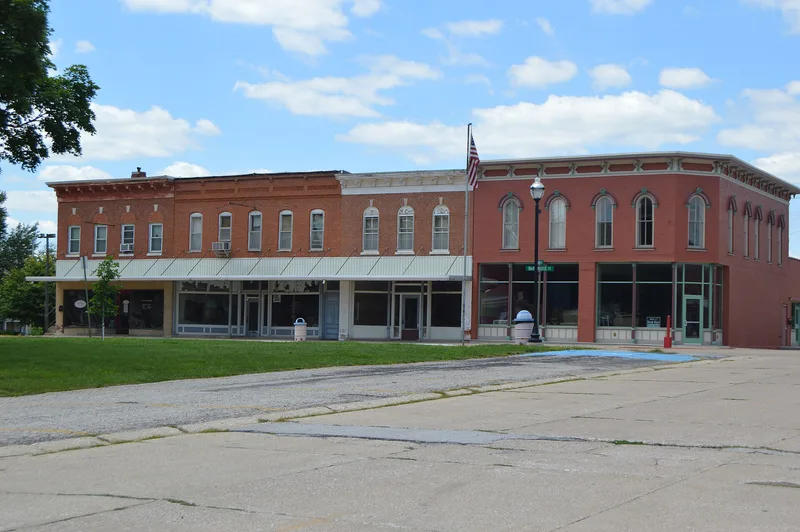

Why it's listed
Barry is a small city in far west-central Illinois, and its historic district covers about 103 acres in the center of town, with an extension east along Mortimer Street. Of 246 structures, 68 were judged to have special architectural or historical significance. Commercial buildings cluster around Bainbridge, Mortimer and Main, mostly two stories and of masonry. In 1894 a major fire destroyed thirty buildings in the business district, and the area was rebuilt within months. At least 20 of the 32 buildings in the core date from that year, and most survive with few alterations, giving the downtown a rare uniformity. Residential streets hold single-family frame houses, many Italianate or Queen Anne, along with plainer 19th-century homes. The town was platted in the early 1830s by Calvin R. Stone and was incorporated as a city in 1872. It never had a railroad and changed little after the mid-1890s, which helped preserve its appearance.
Significance in brief: The district is a well-preserved 19th-century midwestern rural community. Its main significance is the commercial core, where at least 20 of 32 buildings went up in 1894 after a fire destroyed thirty buildings. That gives the business section a homogeneity the nomination calls probably unique. The residential areas add fine Italianate and Queen Anne houses and modest 19th-century homes.
Machine-generated summary. This summary was generated by a language model from the official nomination document and has not been reviewed line by line by an editor. It may contain errors. Check the source document before relying on any detail. Source: nomination document (PDF) · National Archives catalog entry. NRHP reference 79000862, listed March 13, 1979. Summary generated October 2026 (model claude-sonnet-5-5, prompt v1.0-2026-10-29, confidence medium).
Key facts
| Address | U.S. 36, Barry |
|---|---|
| County | Pike County |
| Listed | March 13, 1979 |
| Reference number | 79000862 |
| Resource type | District |
| Architect / builder | George L. Kelly, architect (Brown Library Building, 1903) |
| Architectural style | Late 19th-century commercial eclectic; Italianate; Queen Anne; Carpenter Gothic; Greek Revival; Federal |
| Areas of significance | Architecture |
| Level of significance | State |
| Status (as stated in the nomination) | Occupied, with commercial, residential, religious and park uses; little vacant land. The city's condition is described as relatively stable but stagnant. |
| Acreage | 103 |
| Coordinates | 39.69394, -91.03880 (NPS GIS) |
What listing means for this property
This is a historic district. Buildings within its boundary are either contributing (they add to the district's significance) or non-contributing. Owners of contributing income-producing buildings can claim the 20% federal rehabilitation tax credit; homeowners should look at state credits. National Register districts impose no design review by themselves; a local historic district ordinance, if one exists, does (the difference explained).
General information, not legal or tax advice. Rules change; confirm with your State Historic Preservation Office or a qualified adviser.
Sources and further reading
- National Park Service, National Register of Historic Places database (snapshot May 2026), reference 79000862.
- Nomination form (PDF, National Archives) — catalog entry
- Wikipedia article (used for cross-checking only; text not reproduced here)
- Wikidata Q4864314
- This listing as JSON
Last updated October 2026. Found an error? See the editorial policy for how to report it.