Deere, John, House and Shop

Why it's listed
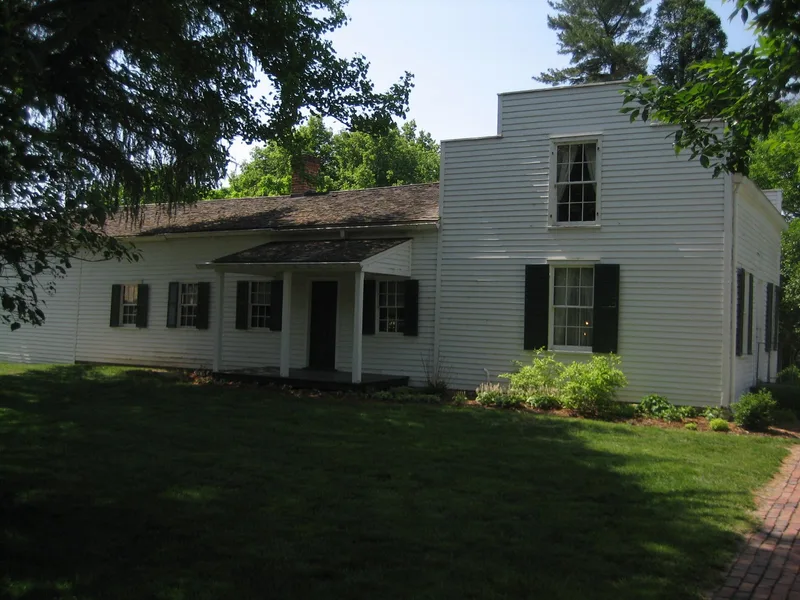
John Deere came to Grand Detour, Illinois, in 1836 and set up a blacksmith shop in the village founded by Leonard Andrus. He built a small house here, probably in 1836, and added to it until he left in 1847. In 1837 he made his first plow, whose steel share and polished moldboard cleared the sticky prairie soil that clogged other plows. This made intensive cultivation possible across Ohio, Indiana and Illinois. By 1843 the firm of Andrus and Deere was producing 400 plows a year. Deere then moved to Moline for better transportation and water power. The roughly four-acre site now includes the clapboarded frame house, the excavated site of the original shop, a reconstructed blacksmith shop and the neighboring Dana House of 1843, used as a visitor center. Katherine Deere Butterworth, his granddaughter, bought the property in 1919, and it later passed to the John Deere Foundation, which restored it.
Significance in brief: This is where John Deere settled in 1836 and made his first plow in 1837, which scoured the sticky prairie soil cleanly. The plow made intensive farming of the old Northwest possible. Deere worked here until 1847, then moved to Moline, where his company grew into a leading farm implement maker.
Machine-generated summary. This summary was generated by a language model from the official nomination document and has not been reviewed line by line by an editor. It may contain errors. Check the source document before relying on any detail. Source: nomination document (PDF) · National Archives catalog entry. NRHP reference 66000327, listed October 15, 1966. Summary generated October 2026 (model claude-sonnet-5-5, prompt v1.0-2026-10-29, confidence medium).
Key facts
| Address | Illinois and Clinton Sts., Grand Detour |
|---|---|
| County | Ogle County |
| Listed | October 15, 1966 |
| Reference number | 66000327 |
| Resource type | Building |
| Period of significance | 1836-1847 |
| Areas of significance | Invention, Agriculture |
| Level of significance | National |
| National Historic Landmark | Yes, designated July 19, 1964 |
| Status (as stated in the nomination) | Restored and maintained as a museum and historic site by the John Deere Foundation; condition listed as excellent, occupied and open to the public. |
| Acreage | 4 |
| Coordinates | 41.89613, -89.41605 (NPS GIS) |
What listing means for this property
National Register listing is honorary for a privately owned home: it does not by itself restrict what an owner may do with their own money, and it does not require public access. Restrictions come from local landmark or historic-district ordinances, which are separate (how they differ).
Owner-occupied houses are not eligible for the 20% federal rehabilitation tax credit, which applies to income-producing buildings, but many states offer credits for homeowners. Listing also opens the door to preservation easements and to buying a plaque. Start with what listing means for homeowners, renovating a listed house and selling one.
General information, not legal or tax advice. Rules change; confirm with your State Historic Preservation Office or a qualified adviser.
Sources and further reading
- National Park Service, National Register of Historic Places database (snapshot May 2026), reference 66000327.
- Nomination form (PDF, National Archives) — catalog entry
- Wikipedia article (used for cross-checking only; text not reproduced here)
- Wikidata Q14687681
- This listing as JSON
Last updated October 2026. Found an error? See the editorial policy for how to report it.