Woodlawn Farm

Approximate location: the National Park Service places this pin arbitrarily within the property, not at a surveyed point (stated accuracy ±12 m).
Why it's listed
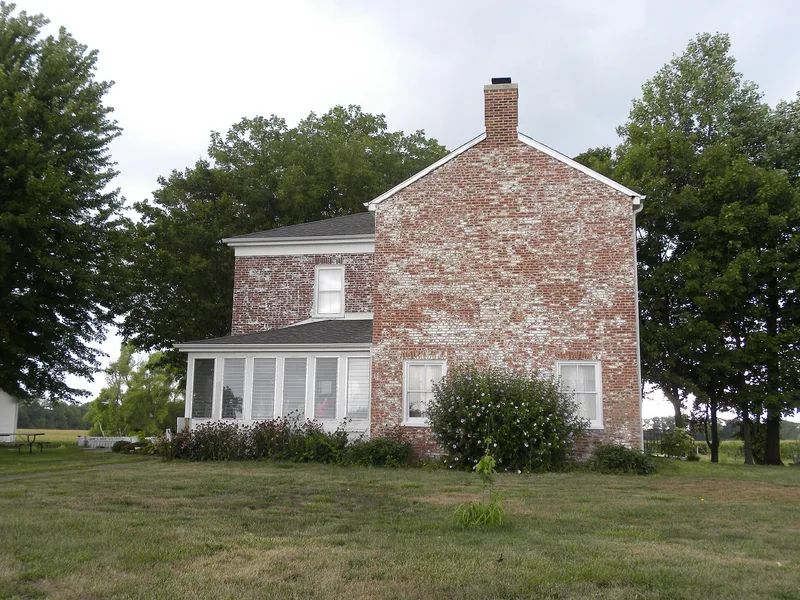
Woodlawn Farm is a six-acre farmstead about three and a half miles east of Jacksonville, Illinois. Its centerpiece is a five-bay, two-and-one-half-story brick I-house with a central hall plan, built around the early 1840s for Michael Huffaker. The plain detailing is primarily Federal, with a deep frieze board and a transom-and-sidelight entrance hinting at the Greek Revival. A large hip-roofed addition was built around 1928 by the Lovekamp family, who modernized the kitchen, bathrooms and wiring while keeping much original material. The farmstead also includes a 1930s barn that replaced one reported to have burned, and an early 20th-century storage building. Huffaker was among the earliest settlers of central Morgan County. Local tradition, though not conclusively documented, says he sheltered escaped slaves here. The property is recognized for showing how a farmhouse changed between 1840 and 1940, and for its association with Huffaker. The Morgan County Historical Society now uses it for interpretation.
Significance in brief: The farmstead is significant under Criterion A for documenting Illinois agricultural history, as the house shows the physical and stylistic changes typical of farmhouses between 1840 and 1940. It is significant under Criterion B for its link to Michael Huffaker, one of the earliest settlers in central Morgan County. Oral tradition holds that Huffaker helped escaped slaves and that the house was an Underground Railroad stop, though the evidence is not conclusive.
Machine-generated summary. This summary was generated by a language model from the official nomination document and has not been reviewed line by line by an editor. It may contain errors. Check the source document before relying on any detail. Source: nomination document (PDF) · National Archives catalog entry. NRHP reference 07000146, listed June 6, 2007. Summary generated October 2026 (model claude-sonnet-5-5, prompt v1.0-2026-10-29, confidence medium).
Key facts
| Address | 1463 Gierke Rd., Jacksonville |
|---|---|
| County | Morgan County |
| Listed | June 6, 2007 |
| Reference number | 07000146 |
| Resource type | Building |
| Period of significance | 1840-1956 |
| Architect / builder | Unknown; John Wolke was contractor for the circa 1928 addition |
| Architectural style | Early Republic/Federal; Other: I-House |
| Criteria |
|
| Areas of significance | Agriculture, Social History |
| Level of significance | Local |
| Status (as stated in the nomination) | Current function is recreation and culture/museum, with work in progress; the Morgan County Historical Society bought the site in 2003 for interpreting Underground Railroad history. |
| Acreage | 6 |
| Coordinates | 39.73564, -90.13890 (NPS GIS) |
What listing means for this property
National Register listing is honorary for a privately owned home: it does not by itself restrict what an owner may do with their own money, and it does not require public access. Restrictions come from local landmark or historic-district ordinances, which are separate (how they differ).
Owner-occupied houses are not eligible for the 20% federal rehabilitation tax credit, which applies to income-producing buildings, but many states offer credits for homeowners. Listing also opens the door to preservation easements and to buying a plaque. Start with what listing means for homeowners, renovating a listed house and selling one.
General information, not legal or tax advice. Rules change; confirm with your State Historic Preservation Office or a qualified adviser.
Sources and further reading
- National Park Service, National Register of Historic Places database (snapshot May 2026), reference 07000146.
- Nomination form (PDF, National Archives) — catalog entry
- Wikipedia article (used for cross-checking only; text not reproduced here)
- Wikidata Q25203163
- This listing as JSON
Last updated October 2026. Found an error? See the editorial policy for how to report it.