Hubbard House

Why it's listed
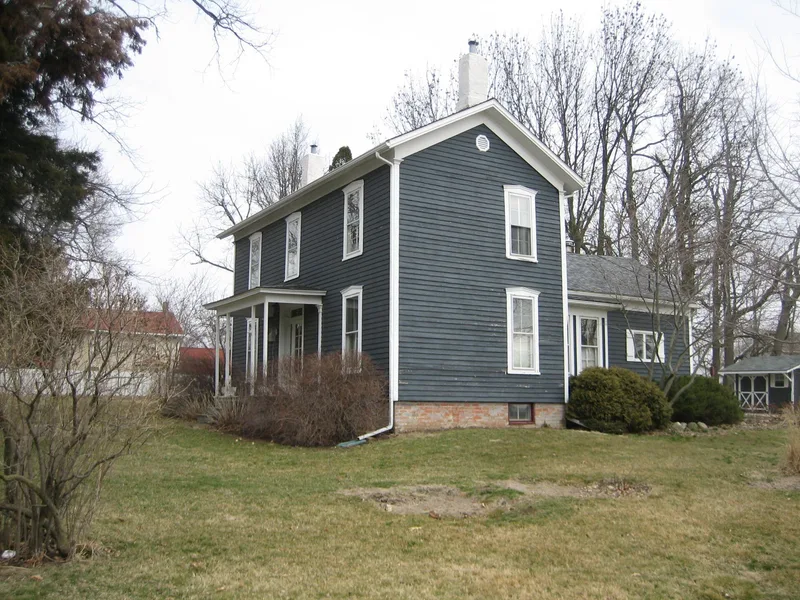
This T-shaped wood house at 310 Broadway in Hudson, Illinois, was the boyhood home of Elbert Hubbard. The oldest section, the stem of the T, is a story and a half high and was built in 1857 from local walnut lumber cut by Dr. Silas Hubbard, the town's first doctor. A two-story crossbar with a gable roof and a small front porch was added about 1872, partly with materials and labor Elbert gathered while collecting his father's bills. A photograph from 1885 shows the house in nearly its present form, and clapboard siding covers the whole structure. Hubbard grew up and attended school in Hudson, then sold soap, became a partner in a Buffalo soap company, and turned to writing in 1892. He produced the Little Journeys essays, published the Philistine, wrote "A Message to Garcia," and founded the Roycroft community at East Aurora. The house was listed for its link to this nationally known author.
Significance in brief: The house was the boyhood home of Elbert Hubbard, a prominent late nineteenth and early twentieth century American essayist. He wrote "A Message to Garcia" and founded the Roycrofters Shops. The nomination argues for national significance in literature, and many of his later writings drew on scenes from his boyhood surroundings here.
Machine-generated summary. This summary was generated by a language model from the official nomination document and has not been reviewed line by line by an editor. It may contain errors. Check the source document before relying on any detail. Source: nomination document (PDF) · National Archives catalog entry. NRHP reference 79003163, listed February 1, 1979. Summary generated October 2026 (model claude-sonnet-5-5, prompt v1.0-2026-10-29, confidence high).
Key facts
| Address | 301 Broadway, Hudson |
|---|---|
| County | McLean County |
| Listed | February 1, 1979 |
| Reference number | 79003163 |
| Resource type | Building |
| Period of significance | 1857, ca. 1872 |
| Areas of significance | Literature |
| Level of significance | National |
| Status (as stated in the nomination) | Listed as in excellent condition, unaltered and on its original site; the form lists present use as private residence. |
| Acreage | 0.9 |
| Coordinates | 40.60916, -88.98800 (NPS GIS) |
What listing means for this property
National Register listing is honorary for a privately owned home: it does not by itself restrict what an owner may do with their own money, and it does not require public access. Restrictions come from local landmark or historic-district ordinances, which are separate (how they differ).
Owner-occupied houses are not eligible for the 20% federal rehabilitation tax credit, which applies to income-producing buildings, but many states offer credits for homeowners. Listing also opens the door to preservation easements and to buying a plaque. Start with what listing means for homeowners, renovating a listed house and selling one.
General information, not legal or tax advice. Rules change; confirm with your State Historic Preservation Office or a qualified adviser.
Sources and further reading
- National Park Service, National Register of Historic Places database (snapshot May 2026), reference 79003163.
- Nomination form (PDF, National Archives) — catalog entry
- Wikipedia article (used for cross-checking only; text not reproduced here)
- Wikidata Q14687572
- This listing as JSON
Last updated October 2026. Found an error? See the editorial policy for how to report it.