Armour's Warehouse
Also known as: Hogan's North Elevator; Seneca Grain Elevator

Why it's listed
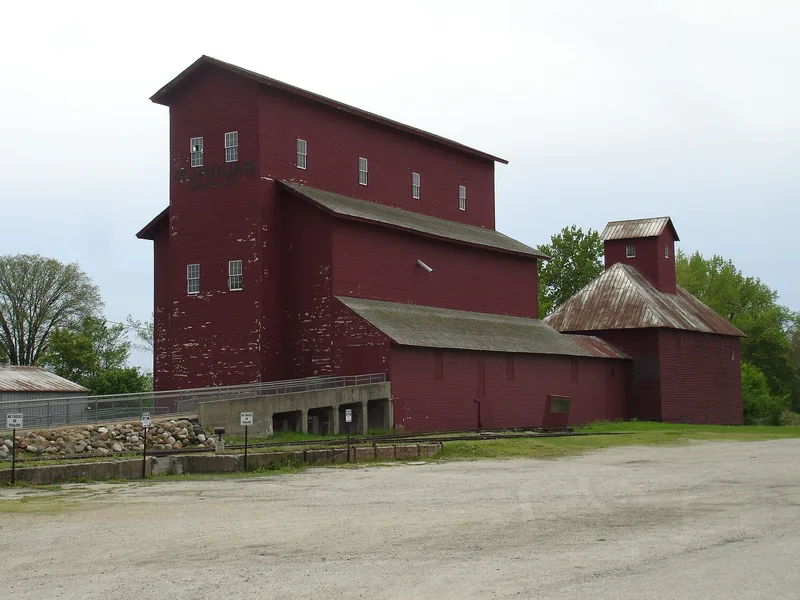
Armour's Warehouse is a wooden grain elevator on the north bank of the Illinois and Michigan Canal in Seneca. John Armour built it around 1861-62. Rising four stories above a basement on a limestone foundation, it measures 40 by 80 feet and is about 65 feet high. Its post-and-beam frame holds 17 studded grain bins, and a leg with rubberized belt and buckets could lift 3,000 bushels an hour. Corrugated metal sheathing was added between 1924 and 1939 over the original clapboard. A dump shed, a 1940s corn crib, an office and seed warehouses sit on the site. Grain once went directly onto canal boats, and a railroad spur added in 1883 reflects the shift to rail shipping. Owners handled large volumes of grain, and the elevator is the oldest and largest surviving one on the canal. Vacant since 1989, it is owned by the State of Illinois, which plans to rehabilitate it as an interpretive center.
Significance in brief: The nomination argues it is the largest and oldest remaining grain elevator on the Illinois and Michigan Canal. It is significant under Criterion A for commerce through its direct link to the grain trade, with transportation and engineering also listed as areas of significance. Its studded bin construction, machinery and later railroad-related changes show how grain handling evolved from canal to rail.
Machine-generated summary. This summary was generated by a language model from the official nomination document and has not been reviewed line by line by an editor. It may contain errors. Check the source document before relying on any detail. Source: nomination document (PDF) · National Archives catalog entry. NRHP reference 97001333, listed November 7, 1997. Summary generated October 2026 (model claude-sonnet-5-5, prompt v1.0-2026-10-29, confidence medium).
Key facts
| Address | Jct. of William and Bridge Sts., Seneca |
|---|---|
| County | LaSalle County |
| Listed | November 7, 1997 |
| Reference number | 97001333 |
| Resource type | Structure |
| Period of significance | c. 1861-1947 |
| Architectural style | Other: wooden grain elevator |
| Criteria |
|
| Areas of significance | Transportation, Commerce, Engineering |
| Level of significance | Local |
| Status (as stated in the nomination) | Vacant since 1989 and in deteriorating condition; the State of Illinois (Department of Natural Resources) owns it and plans to rehabilitate it as an interpretive center for the canal. |
| Acreage | 1.4 |
| Coordinates | 41.32444, -88.61099 (NPS GIS) |
What listing means for this property
For an income-producing building, listing (individually or as a contributing building in a district) is the gateway to the 20% federal rehabilitation tax credit on qualified rehabilitation costs, often stackable with state credits. Work claiming the credit must follow the Secretary of the Interior's Standards and be approved in advance.
Listing does not restrict a private owner acting without federal money or permits; where federal funding or licensing is involved, Section 106 review applies.
Noted as vacant in the nomination. Nomination documents can be decades old; current status may differ. If you are considering buying an empty listed property, read the due-diligence checklist.
General information, not legal or tax advice. Rules change; confirm with your State Historic Preservation Office or a qualified adviser.
Sources and further reading
- National Park Service, National Register of Historic Places database (snapshot May 2026), reference 97001333.
- Nomination form (PDF, National Archives) — catalog entry
- Wikipedia article (used for cross-checking only; text not reproduced here)
- Wikidata Q4793770
- This listing as JSON
Last updated October 2026. Found an error? See the editorial policy for how to report it.