Warren Commercial Historic District

Why it's listed
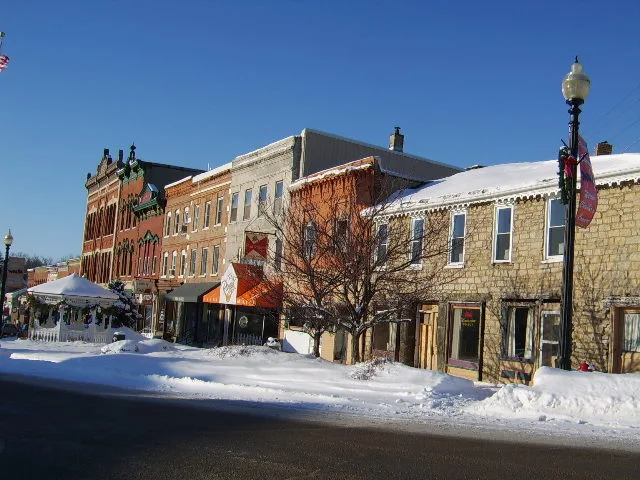
Warren's commercial core sits in a small agricultural community in Jo Daviess County, Illinois, laid out in 1853 along the Illinois Central Railroad. The historic district includes 34 contributing buildings and a 1928 steel water tower, arranged along Main Street, Railroad Street and part of Burnett Street. Most buildings are two-story brick storefronts with metal cornices and cast-iron columns, some supplied by the Mesker ironworks of Evansville, Indiana. Notable examples include the 1891 Auditorium Building, the 1888 Richardson Block, the 1904 Hawley Building, a 1913 Beaux Arts bank, a 1911 Carnegie-funded library, the 1901 railroad depot and the Hotel Warren. Fires in 1887 and 1889 prompted much of the rebuilding. The district reflects Warren's rise as one of the county's largest towns in the 1870s, second only to Galena, and its commercial development through 1945. Later infill and altered facades make up the noncontributing resources.
Significance in brief: The district preserves Warren's late nineteenth and early twentieth century downtown, which grew up after the town was platted in 1853 along the Illinois Central Railroad. Its brick storefronts with cast-iron columns and metal cornices, along with a depot, hotel, library and fire and pump house, reflect the town's commercial and civic life. Many buildings went up after fires in 1887 and 1889.
Machine-generated summary. This summary was generated by a language model from the official nomination document and has not been reviewed line by line by an editor. It may contain errors. Check the source document before relying on any detail. Source: nomination document (PDF) · National Archives catalog entry. NRHP reference 95001241, listed November 7, 1995. Summary generated October 2026 (model claude-sonnet-5-5, prompt v1.0-2026-10-29, confidence medium).
Key facts
| Address | 102-165 E. Main St., 204-210 E. Bunett, 102-108 S. Railroad, Warren |
|---|---|
| County | Jo Daviess County |
| Listed | November 7, 1995 |
| Reference number | 95001241 |
| Resource type | District |
| Period of significance | circa 1852 to 1945 |
| Architectural style | Late Victorian; Classical Revival |
| Areas of significance | Commerce, Architecture |
| Level of significance | Local |
| Status (as stated in the nomination) | Many storefronts have been altered or infilled, though most contributing buildings retain enough integrity to convey the historic character. A second story added to the pump house/fire department building after World War II was slated for removal in a restoration project. |
| Acreage | 9 |
| Coordinates | 42.49590, -89.98742 (NPS GIS) |
What listing means for this property
This is a historic district. Buildings within its boundary are either contributing (they add to the district's significance) or non-contributing. Owners of contributing income-producing buildings can claim the 20% federal rehabilitation tax credit; homeowners should look at state credits. National Register districts impose no design review by themselves; a local historic district ordinance, if one exists, does (the difference explained).
General information, not legal or tax advice. Rules change; confirm with your State Historic Preservation Office or a qualified adviser.
Sources and further reading
- National Park Service, National Register of Historic Places database (snapshot May 2026), reference 95001241.
- Nomination form (PDF, National Archives) — catalog entry
- Wikipedia article (used for cross-checking only; text not reproduced here)
- Wikidata Q24435889
- This listing as JSON
Last updated October 2026. Found an error? See the editorial policy for how to report it.