Bishop Hill Historic District
Also known as: Bishop Hill Colony

Why it's listed
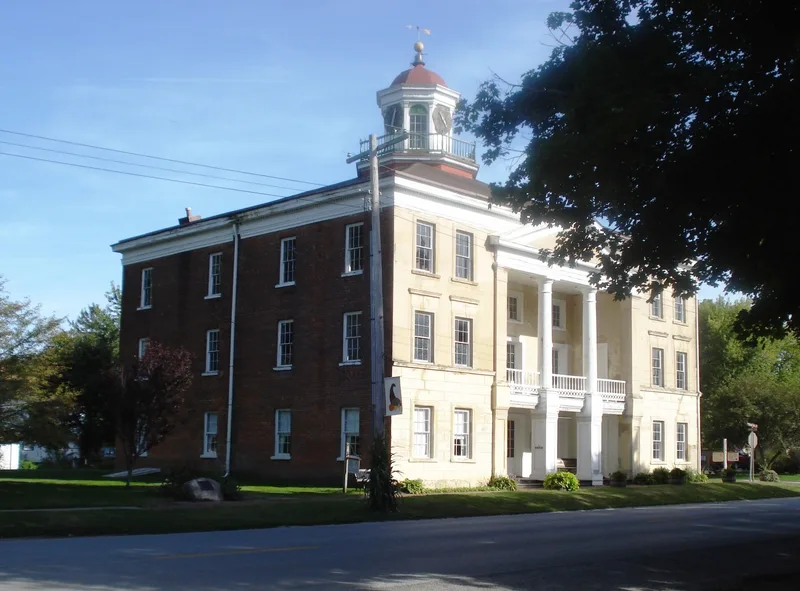
Bishop Hill is a village in Henry County, Illinois, where a historic district of nearly 85 acres preserves the work of a Swedish utopian colony. Members of a fundamentalist religious group, in conflict with the Church of Sweden, began emigrating in 1846 and adopted a communal way of life modeled on the primitive church. They erected fifteen large structures between 1846 and 1861, of which twelve remain nearly unaltered. Among them was the Big Brick, 200 feet long and four stories high, with 96 rooms and a communal dining hall. The buildings are mainly Greek Revival and rise sharply from the prairie. When the colony's property was divided in 1861, families received the rooms they occupied, an early form of condominium ownership. The district is valued as an example of immigrants adapting to a new land, and as the first major Swedish settlement in America since the Delaware Colony. Most residents descend from the original settlers, and Swedish traditions continue.
Significance in brief: The district is significant for the development of the Bishop Hill Colony, a Swedish utopian communal settlement, between 1846 and 1861. It is valued as an example of an ethnic group adapting to a new country, especially in architecture and furnishings. It was the first major Swedish settlement in America since the Delaware Colony and helped draw later Swedish immigration to the Middle West.
Machine-generated summary. This summary was generated by a language model from the official nomination document and has not been reviewed line by line by an editor. It may contain errors. Check the source document before relying on any detail. Source: nomination document (PDF) · National Archives catalog entry. NRHP reference 70000244, listed April 17, 1970. Summary generated October 2026 (model claude-sonnet-5-5, prompt v1.0-2026-10-29, confidence medium).
Key facts
| Address | Off US 34, Bishop Hill |
|---|---|
| County | Henry County |
| Listed | April 17, 1970 |
| Reference number | 70000244 |
| Resource type | District |
| Period of significance | 19th Century (colony development 1846-1861) |
| Architect / builder | Bishop Hill Colony |
| Architectural style | Greek Revival |
| Areas of significance | European, Exploration/Settlement, Social History |
| Level of significance | National |
| National Historic Landmark | Yes, designated April 27, 1984 |
| Status (as stated in the nomination) | Condition rated fair; general repair of the area described as good. Five colony buildings were under restoration by the State of Illinois and local associations, and private owners were restoring colony residences on their exteriors. The area has a strict historic zoning ordinance. |
| Acreage | 150 |
| Coordinates | 41.20051, -90.11857 (NPS GIS) |
What listing means for this property
This is a historic district. Buildings within its boundary are either contributing (they add to the district's significance) or non-contributing. Owners of contributing income-producing buildings can claim the 20% federal rehabilitation tax credit; homeowners should look at state credits. National Register districts impose no design review by themselves; a local historic district ordinance, if one exists, does (the difference explained).
General information, not legal or tax advice. Rules change; confirm with your State Historic Preservation Office or a qualified adviser.
Sources and further reading
- National Park Service, National Register of Historic Places database (snapshot May 2026), reference 70000244.
- Nomination form (PDF, National Archives) — catalog entry
- Wikipedia article (used for cross-checking only; text not reproduced here)
- Wikidata Q4917593
- This listing as JSON
Last updated October 2026. Found an error? See the editorial policy for how to report it.