Phelps, Alexis, House

Why it's listed
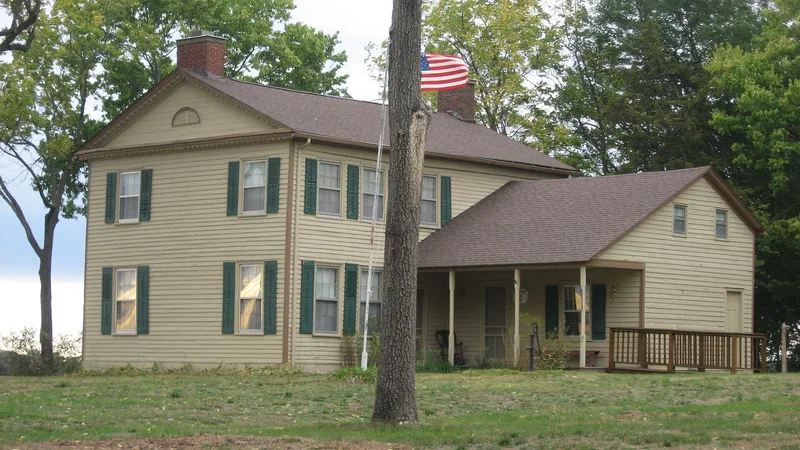
Built around 1833 on the Mississippi River bluff in Oquawka, Illinois, this two-story frame house was the home of Alexis Phelps. He and his brother Stephen ran a trading post with the Sac and Fox at a spot called Yellow Banks, then plotted the town in 1836 and sold lots. The house therefore predates Oquawka itself. When Henderson County was separated from Warren County in 1841, the brothers donated land for a courthouse, bringing the county seat to the town, and Alexis built the courthouse. Stephen Douglas was a frequent guest in the house. The structure has black walnut siding, studs and trim, a stone foundation, and a simple four-over-four room layout. Changes include a mid-1800s kitchen wing, 1920s porch and garage additions, asbestos shingles added in 1946, and an entrance moved from west to south as the riverbank eroded. It is vacant, and the county historical society hopes to restore it.
Significance in brief: The house predates the town of Oquawka and is a direct link to the exploration and settlement of Henderson County. Alexis Phelps and his brother Stephen traded with the Sac and Fox, laid out the town, and helped win the county seat. Alexis also built the county courthouse in 1841.
Machine-generated summary. This summary was generated by a language model from the official nomination document and has not been reviewed line by line by an editor. It may contain errors. Check the source document before relying on any detail. Source: nomination document (PDF) · National Archives catalog entry. NRHP reference 82002537, listed April 28, 1982. Summary generated October 2026 (model claude-sonnet-5-5, prompt v1.0-2026-10-29, confidence high).
Key facts
| Address | On Mississippi River, Oquawka |
|---|---|
| County | Henderson County |
| Listed | April 28, 1982 |
| Reference number | 82002537 |
| Resource type | Building |
| Period of significance | 1800-1899 |
| Architect / builder | Alexis Phelps |
| Areas of significance | Exploration/Settlement |
| Level of significance | Local |
| Status (as stated in the nomination) | Listed as vacant and in fair condition; the county historical society owns it and hopes to restore it. |
| Acreage | 0.9 |
| Coordinates | 40.93337, -90.95015 (NPS GIS) |
What listing means for this property
National Register listing is honorary for a privately owned home: it does not by itself restrict what an owner may do with their own money, and it does not require public access. Restrictions come from local landmark or historic-district ordinances, which are separate (how they differ).
Owner-occupied houses are not eligible for the 20% federal rehabilitation tax credit, which applies to income-producing buildings, but many states offer credits for homeowners. Listing also opens the door to preservation easements and to buying a plaque. Start with what listing means for homeowners, renovating a listed house and selling one.
Noted as vacant in the nomination. Nomination documents can be decades old; current status may differ. If you are considering buying an empty listed property, read the due-diligence checklist.
General information, not legal or tax advice. Rules change; confirm with your State Historic Preservation Office or a qualified adviser.
Sources and further reading
- National Park Service, National Register of Historic Places database (snapshot May 2026), reference 82002537.
- Nomination form (PDF, National Archives) — catalog entry
- Wikipedia article (used for cross-checking only; text not reproduced here)
- Wikidata Q15179183
- This listing as JSON
Last updated October 2026. Found an error? See the editorial policy for how to report it.